
TEM MEMS Heating + Biasing sample holder - nanoparticle coalescence
Cheng-Yu Chen and Eric A. Stach from University of Pennsylvania, along with Duncan Burns and Peter Voorhees from Northwestern University, published their work using the Hummingbird Scientific in-situ TEM MEMS Heating + Biasing Sample Holder to investigate how substrate heterogeneity influences the evolution of supported nanoparticles at elevated temperatures. They deposited monolayer Pt nanoparticles, approximately 2.5 nm in radius, on SiNₓ heating chips and heated them to 800 °C inside the TEM for more than 1.5 hours, while continuously exposing selected regions to the electron beam.
As the samples were heated and irradiated, the electron beam induced localized crystalline Si nanodomains within the SiNₓ substrate. Where Pt nanoparticles contacted these domains, they transformed into the more mobile Pt₃Si phase, leading to enhanced particle mobility. Time-resolved imaging then captured nanoparticles undergoing directional migration rather than purely random motion. This change in behavior was reflected in the substantially higher coalescence observed in exposed regions, where approximately 30% of particles sintered compared with 3.7% in unexposed regions.
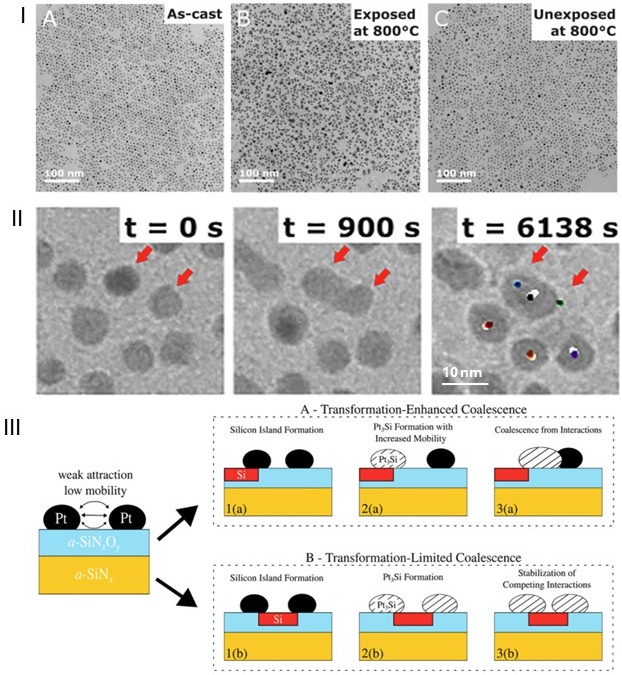
(I) TEM images showing Pt nanoparticles in the as-cast (A), electron-beam-exposed at 800 °C (B), and unexposed at 800°C (C) regions, highlighting enhanced coalescence following heating and electron-beam exposure. (II) Time-sequence TEM images showing particle–substrate interactions and directional nanoparticle migration during in-situ heating, from t = 0 s to t = 6138 s. (III) Schematic illustration of the proposed transformation-enhanced and transformation-limited coalescence pathways: initially, Pt nanoparticles on an amorphous SiNₓOᵧ surface exhibit weak attraction and low mobility; silicon island formation can promote Pt-to-Pt₃Si transformation and increased mobility, leading either to coalescence through reinforcing interactions (A) or stabilization and inhibited coalescence through competing Pt₃Si–Si interactions (B). Image Copyright© 2025 American Chemical Society
To establish the mechanism behind these observations, the researchers combined the time-resolved TEM data with selected-area electron diffraction (SAED), high-resolution TEM (HRTEM), automated particle tracking, and phase-field modeling. These complementary approaches linked the directional motion to interfacial energy gradients created by the heterogeneous substrate. Depending on the location of the Si domains, these gradients could steer nanoparticles toward one another and promote coalescence, or act as barriers that prevented particles from merging. The Hummingbird Scientific in-situ TEM MEMS Heating + Biasing Sample Holder enabled this study by providing controlled high-temperature heating directly inside the TEM, allowing the researchers to connect evolving substrate structure and phase transformations with nanoparticle dynamics in real time.
Reference:
Cheng-Yu Chen, Duncan Burns, Peter W. Voorhees, and Eric A. Stach, Interfacial Energy Gradients Drive Coalescence of Supported Nanoparticles. ACS Nano 19(49), 41623-41636 (2025) DOI: 10.1021/acsnano.5c13727
Copyright© 2025 American Chemical Society