How does in-situ characterization change our understanding of nucleation and growth mechanisms?
Hummingbird Scientific in-situ sample holders enable real-time, atomic-resolution study of nanomaterial nucleation and growth, linking formation pathways to final structure, morphology, and function. Conduct multimodal TEM, SEM, and X-ray experiments in gas, liquid, and vacuum environments, with closed-loop temperature control above 1000 °C to capture nucleation, phase transformations, and reaction kinetics.
Each holder is designed for performance, reproducibility, and ease of use. Explore synthesis experiment types, published examples, and compatible Hummingbird products below.

Which type of experiment best matches your research?

Biomineralization Processes
Visualize nucleation, growth, and phase evolution during biomineralization under liquid-phase conditions.

Biomineralization Processes
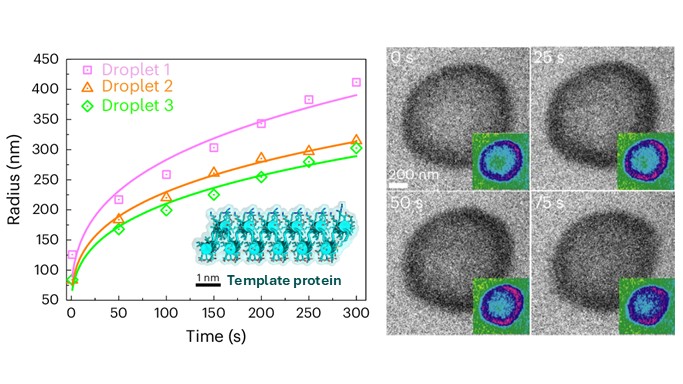
Capturing the formation and evolution of dense liquid phase of calcium (bi) carbonate
In situ liquid-phase TEM captured nonclassical calcium (bi)carbonate nucleation via a transient, highly hydrated dense liquid phase (DLP), resolving its formation and transformation in real time.
- DLPs formed in a sealed liquid cell from CaCl2, NaHCO3, and polyacrylic acid or a carboxylic acid-rich de-novo-designed helical repeat protein via liquid-liquid phase separation (LLPS) of solvated Ca2+–(HCO3-)2 complexes.
- DLP evolved from droplets to branched networks and solidified into hollow amorphous calcium carbonate.
- The findings resolve nonclassical nucleation pathways and inform control of carbonate mineralization for biomaterials, geochemistry, and CO2 sequestration.
Reference: Biao Jin, et al, Nat. Mater. 24, 125–132 (2025). DOI: 10.1038/s41563-024-02025-5
Image copyright © 2024, The Author(s), under exclusive license to Springer Nature Limited
Dissolution-renucleation processes
Visualize dissolution, nucleation, and particle growth in real time during liquid-phase synthesis.
Dissolution-renucleation processes
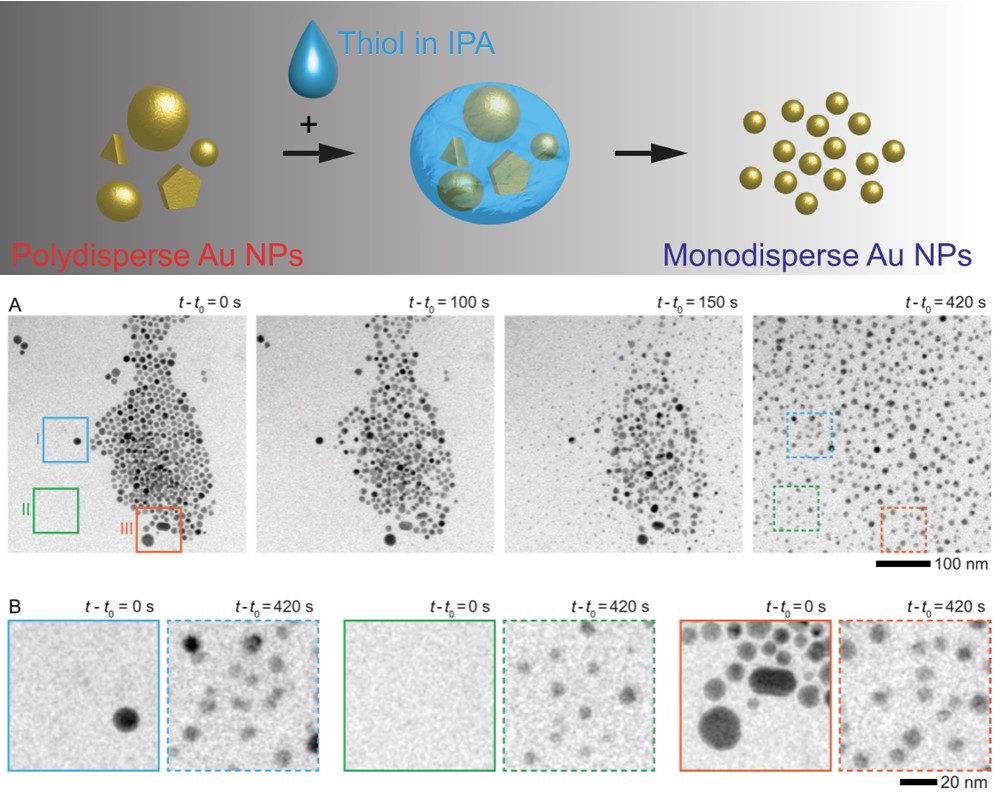
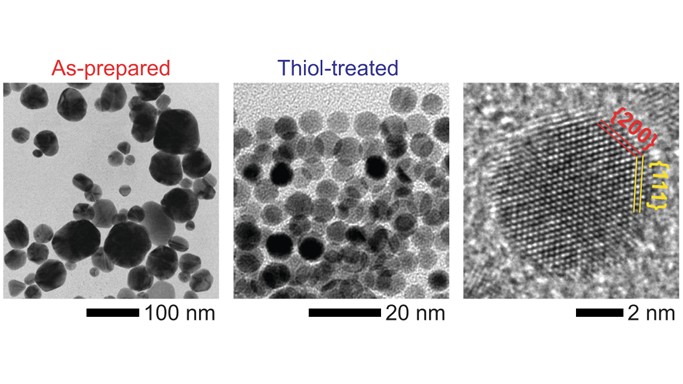
Size-focusing of Au nanoparticles (NPs) via liquid-phase dissolution-renucleation process
Transformation of polydispersed Au nanoparticles into monodisperse sub-10 nm particles was observed in the presence of thiol ligands via in-situ liquid phase TEM.
- An as-prepared Au nanoparticle dispersion was introduced into an in situ liquid cell, followed by the controlled flow of a thiol solution in isopropyl alcohol.
- Real-time imaging was conducted at both room temperature and elevated temperature (80 °C).
- Initial dissolution of the polydisperse nanoparticles was observed, followed by the nucleation and growth of smaller, highly monodisperse nanoparticles.
- These results challenge size-focusing models of etching and splitting, instead revealing a dissolution–reprecipitation pathway for producing uniform NPs.
Reference: Wenhui Wang, et al, Small Methods 9, 11, e01033 (2025). DOI: 10.1002/smtd.202501033
Image copyright © 2025 Wiley-VCH GmbH

Growth and Shape Evolution of Nanocrystals
Capture nucleation, crystal growth, and morphology development during liquid-phase synthesis.
Growth and Shape Evolution of Nanocrystals
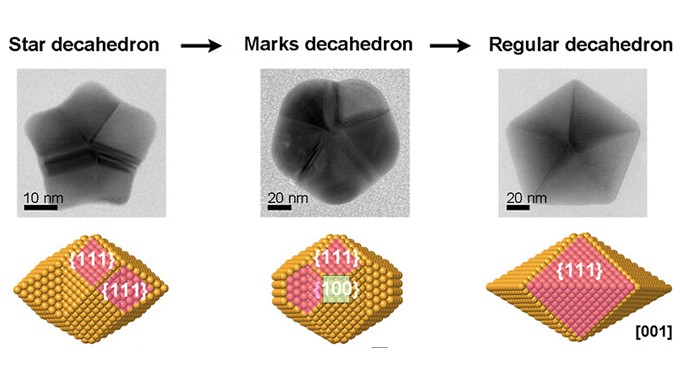
Growth and shape evolution of gold decahedral nanocrystals
In-situ liquid-phase TEM was used to visualize the growth and shape evolution of gold nanocrystals, while systematically varying electron dose, precursor concentration, and ligand chemistry.
- HAuCl4 was used as a precursor solution.
- Electron dose rates of 0.06-78.0 e−/Å2 s and additives such as polyvinylpyrrolidone (PVP) and cetyltrimethylammonium bromide (CTAB) at different concentrations were used to modulate crystal shape.
- The work provides unprecedented insight into dynamic growth pathways and size-dependent structural transitions that govern metal nanocrystal morphology.
Reference: Xiaoming Ma, et al, ACS Nano 19, 43, 38173-38183 (2025). DOI: 10.1021/acsnano.5c15982
Image copyright © 2025 American Chemical Society

Gas Phase Growth of Nanomaterials
Capture nanomaterial nucleation, growth, and morphology evolution during gas-phase synthesis.
Gas Phase Growth of Nanomaterials
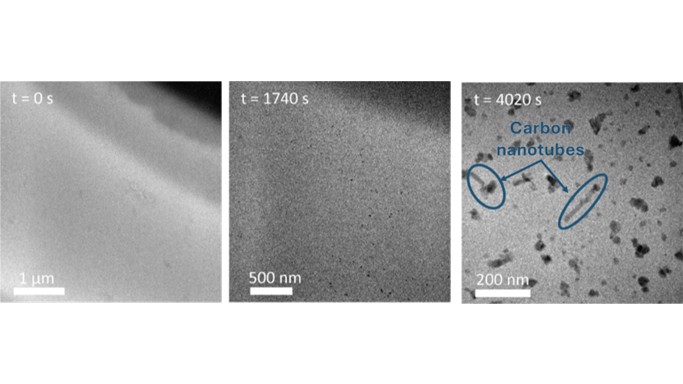
In-situ chemical vapor deposition (CVD) of carbon nanotubes (CNT) and nanofibers (CNF)
The effect of different Fe-based alloy catalyst systems on in-situ atmospheric pressure CVD of CNTs and CNFs was characterized.
- Fe, Fe + Na2CO3, and stainless-steel catalysts were evaluated at 775º C under H2/C2H4 (5:2) flow (up to 5 sccm) for in-situ CNT/CNF growth.
- Na2CO3 (desiccant effect) and Cr in stainless steel (oxygen scavenging) significantly enhanced CNT/CNF yield.
- EDS and EELS confirmed oxygen capture by chromium in stainless steel.
- The results provide pathways to optimize growth and enable deeper insight into CVD processes.
Reference: Andrew C. Meng, et al, J. Vac. Sci. Technol. B 43, 040601 (2025). DOI: 10.1116/6.0004664
Image copyright © 2026 AIP Publishing LLC

Nanoparticle self-assembly processes
Study self-assembly processes and structural dynamics of nanoparticles in liquid environments.
Nanoparticle self-assembly processes
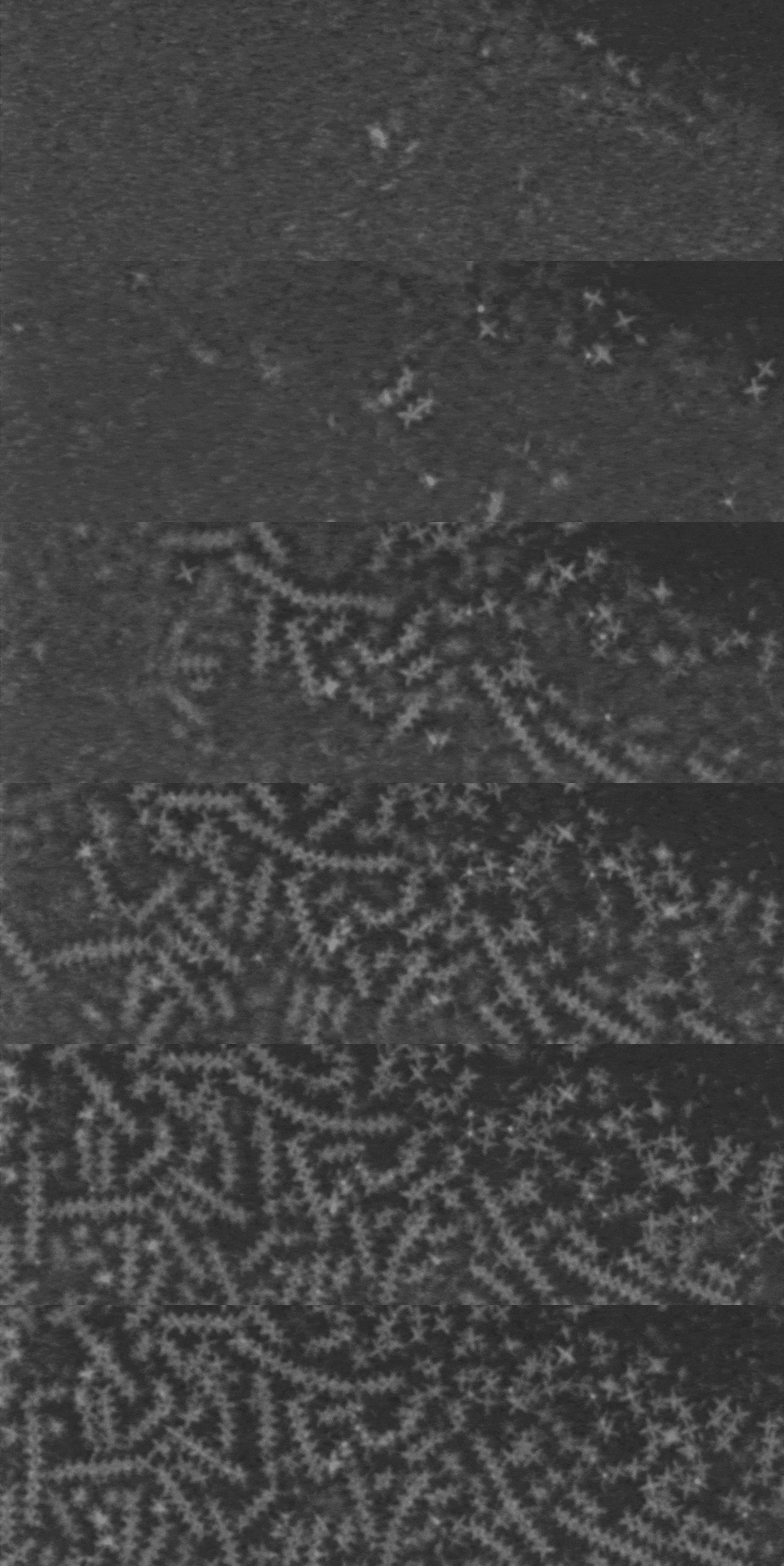
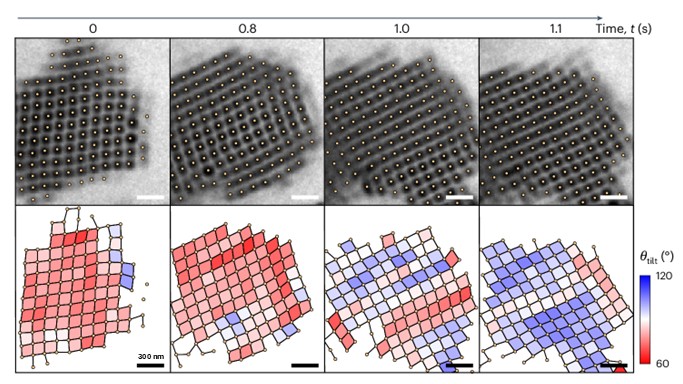
Phonon dynamics in self-assembled gold nanoparticles (NPs)
Maxwell lattices obtained by self-assembly of gold NPs were used to resolve phonon dynamics using liquid phase TEM.
- Shape-controlled gold nanoparticles (nanocubes, nanorods, and nanoprisms) coated with CTAB ligands were used as building blocks for self-assembly.
- The self-assembly process and post-assembly structural dynamics across different particle geometries were imaged via in-situ liquid phase TEM.
- Nanoscale vibrations of individual particles were tracked to extract phonon dynamics within the assembled lattices.
- These insights establish design pathways for engineering topological states in self-assembled nanostructures, advancing their use in mechanical metamaterials.
Reference: Chang Qian, et al, Nat. Mater. 24, 1616–1625 (2025). DOI: 10.1038/s41563-025-02253-3
Image copyright © 2025 Springer Nature Limited

Growth of Metal-Organic Frameworks (MOFs)
Investigate MOF nucleation and crystal growth during liquid-phase synthesis.
Growth of Metal-Organic Frameworks (MOFs)
Formation and growth of metal NP@MOF hybrid nanostructures
Encapsulation of Au NPs by zeolitic imidazolate framework-8 (ZIF-8) was visualized by in-situ liquid phase TEM at ultra-low electron-flux.
- Speed of MOF growth impacts the shape of the shell.
- Low precursor concentration leads to well-defined single-crystalline MOFs.
- High precursor concentration leads to multiple nucleation sites on NP surface resulting in polycrystalline MOFs
- The study demonstrates low electron flux imaging, which can be extended to imaging several beam-sensitive materials.
Reference: Guoming Lin & Utkur Mirsaidov, Adv. Sci. 12, 25, 2500984 (2025). DOI: 10.1002/advs.202500984
Image from Advanced Science under the Creative Commons license

Electrochemical Growth
Study electrochemical growth mechanisms and nanoscale morphology evolution in liquid environments.
Electrochemical Growth
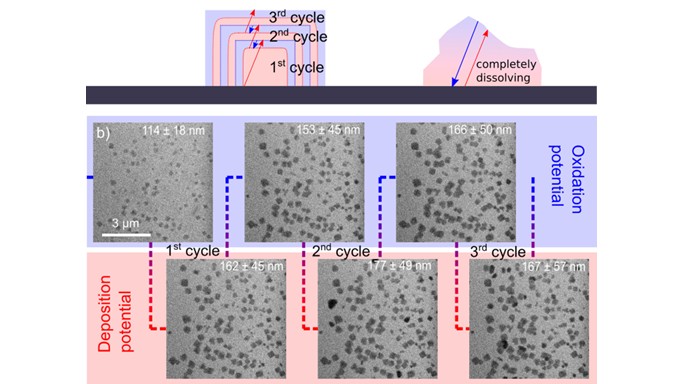
Repeatable Cu nanocube electrochemical growth–dissolution cycles visualized via in-situ liquid SEM
Reversible growth and dissolution of Cu nanocubes (NCs) was captured via in-situ liquid phase SEM, directly correlating redox cycling with morphological evolution.
- Cu NCs were electrodeposited on glassy carbon substrates to explore their potential in electrochemical CO2 reduction (CO2RR).
- Chloride ion concentration, redox timing ratios, and number of deposition cycles were tuned to control NC shape, size, and yield.
- The work demonstrates in-situ liquid electrochemical TEM as a powerful platform for controlled growth and characterization of nano-catalysts.
Reference: Philipp Grosse, et al, J. Phys. Chem. C 124, 49, 26908-26915 (2020). DOI: 10.1021/acs.jpcc.0c09105
Image from The Journal of Physical Chemistry C under the Creative Commons license

Temperature Dependent Crystal Growth
Visualize how temperature influences crystal growth pathways and nanostructure formation in liquid environments.
Temperature Dependent Crystal Growth
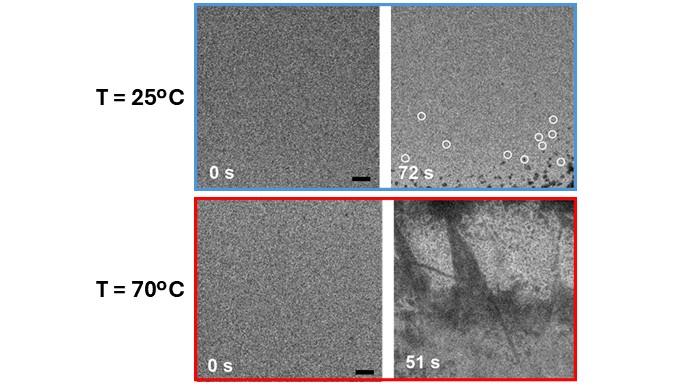
Ag nanocrystal growth rates and morphology at different temperatures
Growth of Ag nanocrystals during electron beam exposure of silver nitrate at temperatures 25-70 °C was observed using in-situ liquid phase TEM.
- 0.01 M AgNO3 solution was irradiated with a constant dose rate of 2.8x10⁷ Gy/s at different temperatures.
- Compact, isotropic nanocrystals formed at lower temperatures, while higher temperatures promoted the growth of blade-like dendritic structures.
- The results showcase how liquid phase TEM combined with a detailed, temperature-dependent radiolysis model can help develop an understanding of temperature dependent beam-induced nanocrystal growth.
Reference: Serin Lee, et al, ACS Nano 17, 6, 5609-5619 (2023). DOI: 10.1021/acsnano.2c11477
Image copyright © 2023 American Chemical Society

Low dimensional materials synthesis
Study the formation, growth, and structural evolution of low-dimensional materials under non-equilibrium conditions.
Low dimensional materials synthesis
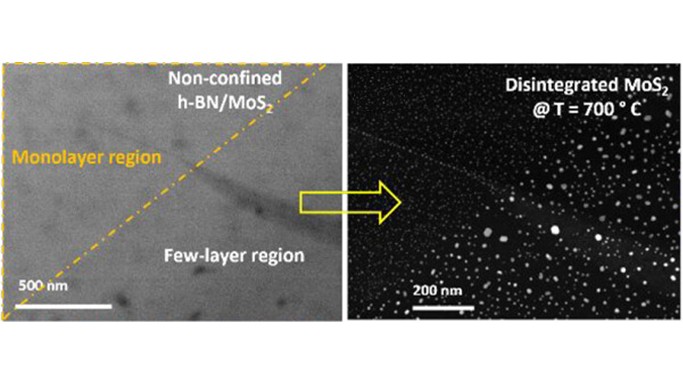
2D transition metal dichalcogenide (TMDC) nanocrystal synthesis in rapidly heated van der Waals heterostructures
Sub-10 nm 2D nanocrystals were synthesized using ultrafast migration of vacancies during non-equilibrium thermolysis of 2D material flakes.
- Single-crystalline monolayer and few-layer TMDC flakes either supported or encapsulated by hexagonal boron nitride (h-BN) were thermolyzed.
- Supported monolayers resulted on ~5 nm particles, whereas few-layer structures resulted in ~10 nm particles.
- Encapsulation resulted in a decrease in thermolysis temperature and highly crystalline and stoichiometric nanoparticles
- The work opens a new route for produce crystalline 0D and 1D nanostructures from 2D van der Waals layers.
Reference: Pawan Kumar, et al, ACS Appl. Mater. Interfaces 15, 51, 59693-59703 (2023). DOI: 10.1021/acsami.3c13471
Image copyright © 2023 American Chemical Society
Biomineralization Processes
Visualize nucleation, growth, and phase evolution during biomineralization under liquid-phase conditions.
Dissolution-renucleation processes
Visualize dissolution, nucleation, and particle growth in real time during liquid-phase synthesis.
Growth and Shape Evolution of Nanocrystals
Capture nucleation, crystal growth, and morphology development during liquid-phase synthesis.
Gas Phase Growth of Nanomaterials
Capture nanomaterial nucleation, growth, and morphology evolution during gas-phase synthesis.
Nanoparticle self-assembly processes
Study self-assembly processes and structural dynamics of nanoparticles in liquid environments.
_thumbnail.jpg)
Growth of Metal-Organic Frameworks (MOFs)
Investigate MOF nucleation and crystal growth during liquid-phase synthesis.
Electrochemical Growth
Study electrochemical growth mechanisms and nanoscale morphology evolution in liquid environments.
Temperature Dependent Crystal Growth
Visualize how temperature influences crystal growth pathways and nanostructure formation in liquid environments.
Low dimensional materials synthesis
Study the formation, growth, and structural evolution of low-dimensional materials under non-equilibrium conditions.
Browse publications
Nano Letters
Science
CrystEngComm
Small Methods
Research Spotlight
LPTEM movie of gold nanocube transitioning from fully disordered to fully ordered states with overlayed Ollivier-Ricci Curvature (ORC) maps (left) and Augmented Forman-Ricci Curvature(AFRC) maps (right). Scale bars, 200 nm.
Observing nanoparticle self-assembly under liquid environment
Understanding how assembly dynamics emerge at the nanoscale is key to advancing functional nanomaterials. The Hummingbird Scientific liquid flow sample holder enabled stable, real-time recordings of assembly motifs to be combined with graph theory analysis to link structural complexity to functional material behavior.
The video shows wide-frame, time-resolved liquid-phase TEM tracking the self-assembly of more than 400 gold nanocubes in solution as they transitioned from freely dispersed particles into ordered superlattices. Advanced image segmentation and graph-based analysis converted each time-resolved TEM frame into dynamic particle interaction networks, enabling the researchers to quantify both local and system-wide structural evolution in real time according to two advanced graph theory curvature metrics. Their analysis revealed a “Goldilocks” regime of intermediate complexity, where partially ordered, dynamically interconnected mesocrystal networks generated the strongest near-infrared plasmonic response.
Hummingbird Advantages
- Sealed, electron-transparent liquid cell allows imaging under continuous liquid flow.
- Mechanically stable holder design enables nearly drift-free imaging allowing accurate particle tracking.
Reference: Jonas Hallstrom, et al, Science. (2026). DOI: 10.1126/science.aeb5134
Video Copyright © 2026 The Authors, some rights reserved; exclusive licensee American Association for the Advancement of Science.
Why choose Hummingbird Scientific for your research?
Hummingbird Scientific supports in situ synthesis research with flexible microscopy platforms, customizable sample chips, direct scientist support, internal TEM lab expertise, and in-house engineering and manufacturing capabilities.
Broader options for in situ synthesis experiments
Synthesis research spans nucleation, crystal growth, nanoparticle formation, self-assembly, phase transformations, vapor-phase deposition, liquid-liquid reactions, and thermal processing. Hummingbird supports these workflows with TEM, SEM, and synchrotron X-ray microscopy platforms for liquid flow, gas flow, high-pressure gas, heating, electrical biasing, and optical illumination experiments. This gives researchers the flexibility to match the experimental platform to the synthesis route, reaction environment, and characterization objectives.
More chip choices for experimental flexibility
Microfabricated chip design plays a critical role in defining the reaction environment, temperature control, fluid handling, and analytical performance of synthesis experiments. Through our dedicated microfabrication division, Hummingbird develops standard and custom chips for liquid flow, gas flow, heating, electrical biasing, spacer thicknesses, window geometries, microfluidic layouts, and specialized sample architectures. This enables researchers to tailor the experimental platform to their synthesis process while maintaining compatibility across TEM, SEM, and synchrotron X-ray microscopy.
Scientist support backed by an internal TEM Lab
Synthesis researchers work directly with scientists and technical staff who understand the practical details of in situ and operando TEM workflows. Hummingbird’s internal TEM Lab allows our team to evaluate microscope-facing performance during development, including alignment, handling, imaging stability, sample-environment behavior, and workflow usability under real TEM conditions.
Engineering, production, and custom capability
Hummingbird's in-house capabilities connect engineering, microfabrication, manufacturing, assembly, calibration, and testing within one development process. For synthesis research, that means standard products can be supported by custom chips and holder configurations, and application-specific workflow changes when the experiment requires something more specific.
Biomineralization Processes
Visualize nucleation, growth, and phase evolution during biomineralization under liquid-phase conditions.
Biomineralization Processes
Capturing the formation and evolution of dense liquid phase of calcium (bi) carbonate
In situ liquid-phase TEM captured nonclassical calcium (bi)carbonate nucleation via a transient, highly hydrated dense liquid phase (DLP), resolving its formation and transformation in real time.
- DLPs formed in a sealed liquid cell from CaCl2, NaHCO3, and polyacrylic acid or a carboxylic acid-rich de-novo-designed helical repeat protein via liquid-liquid phase separation (LLPS) of solvated Ca2+–(HCO3-)2 complexes.
- DLP evolved from droplets to branched networks and solidified into hollow amorphous calcium carbonate.
- The findings resolve nonclassical nucleation pathways and inform control of carbonate mineralization for biomaterials, geochemistry, and CO2 sequestration.
Reference: Biao Jin, et al, Nat. Mater. 24, 125–132 (2025). DOI: 10.1038/s41563-024-02025-5
Image copyright © 2024, The Author(s), under exclusive license to Springer Nature Limited
Dissolution-renucleation processes
Visualize dissolution, nucleation, and particle growth in real time during liquid-phase synthesis.
Dissolution-renucleation processes
Size-focusing of Au nanoparticles (NPs) via liquid-phase dissolution-renucleation process
Transformation of polydispersed Au nanoparticles into monodisperse sub-10 nm particles was observed in the presence of thiol ligands via in-situ liquid phase TEM.
- An as-prepared Au nanoparticle dispersion was introduced into an in situ liquid cell, followed by the controlled flow of a thiol solution in isopropyl alcohol.
- Real-time imaging was conducted at both room temperature and elevated temperature (80 °C).
- Initial dissolution of the polydisperse nanoparticles was observed, followed by the nucleation and growth of smaller, highly monodisperse nanoparticles.
- These results challenge size-focusing models of etching and splitting, instead revealing a dissolution–reprecipitation pathway for producing uniform NPs.
Reference: Wenhui Wang, et al, Small Methods 9, 11, e01033 (2025). DOI: 10.1002/smtd.202501033
Image copyright © 2025 Wiley-VCH GmbH
Growth and Shape Evolution of Nanocrystals
Capture nucleation, crystal growth, and morphology development during liquid-phase synthesis.
Growth and Shape Evolution of Nanocrystals
Growth and shape evolution of gold decahedral nanocrystals
In-situ liquid-phase TEM was used to visualize the growth and shape evolution of gold nanocrystals, while systematically varying electron dose, precursor concentration, and ligand chemistry.
- HAuCl4 was used as a precursor solution.
- Electron dose rates of 0.06-78.0 e−/Å2 s and additives such as polyvinylpyrrolidone (PVP) and cetyltrimethylammonium bromide (CTAB) at different concentrations were used to modulate crystal shape.
- The work provides unprecedented insight into dynamic growth pathways and size-dependent structural transitions that govern metal nanocrystal morphology.
Reference: Xiaoming Ma, et al, ACS Nano 19, 43, 38173-38183 (2025). DOI: 10.1021/acsnano.5c15982
Image copyright © 2025 American Chemical Society
Gas Phase Growth of Nanomaterials
Capture nanomaterial nucleation, growth, and morphology evolution during gas-phase synthesis.
Gas Phase Growth of Nanomaterials
In-situ chemical vapor deposition (CVD) of carbon nanotubes (CNT) and nanofibers (CNF)
The effect of different Fe-based alloy catalyst systems on in-situ atmospheric pressure CVD of CNTs and CNFs was characterized.
- Fe, Fe + Na2CO3, and stainless-steel catalysts were evaluated at 775º C under H2/C2H4 (5:2) flow (up to 5 sccm) for in-situ CNT/CNF growth.
- Na2CO3 (desiccant effect) and Cr in stainless steel (oxygen scavenging) significantly enhanced CNT/CNF yield.
- EDS and EELS confirmed oxygen capture by chromium in stainless steel.
- The results provide pathways to optimize growth and enable deeper insight into CVD processes.
Reference: Andrew C. Meng, et al, J. Vac. Sci. Technol. B 43, 040601 (2025). DOI: 10.1116/6.0004664
Image copyright © 2026 AIP Publishing LLC
Nanoparticle self-assembly processes
Study self-assembly processes and structural dynamics of nanoparticles in liquid environments.
Nanoparticle self-assembly processes
Phonon dynamics in self-assembled gold nanoparticles (NPs)
Maxwell lattices obtained by self-assembly of gold NPs were used to resolve phonon dynamics using liquid phase TEM.
- Shape-controlled gold nanoparticles (nanocubes, nanorods, and nanoprisms) coated with CTAB ligands were used as building blocks for self-assembly.
- The self-assembly process and post-assembly structural dynamics across different particle geometries were imaged via in-situ liquid phase TEM.
- Nanoscale vibrations of individual particles were tracked to extract phonon dynamics within the assembled lattices.
- These insights establish design pathways for engineering topological states in self-assembled nanostructures, advancing their use in mechanical metamaterials.
Reference: Chang Qian, et al, Nat. Mater. 24, 1616–1625 (2025). DOI: 10.1038/s41563-025-02253-3
Image copyright © 2025 Springer Nature Limited
Growth of Metal-Organic Frameworks (MOFs)
Investigate MOF nucleation and crystal growth during liquid-phase synthesis.
Growth of Metal-Organic Frameworks (MOFs)
Formation and growth of metal NP@MOF hybrid nanostructures
Encapsulation of Au NPs by zeolitic imidazolate framework-8 (ZIF-8) was visualized by in-situ liquid phase TEM at ultra-low electron-flux.
- Speed of MOF growth impacts the shape of the shell.
- Low precursor concentration leads to well-defined single-crystalline MOFs.
- High precursor concentration leads to multiple nucleation sites on NP surface resulting in polycrystalline MOFs
- The study demonstrates low electron flux imaging, which can be extended to imaging several beam-sensitive materials.
Reference: Guoming Lin & Utkur Mirsaidov, Adv. Sci. 12, 25, 2500984 (2025). DOI: 10.1002/advs.202500984
Image from Advanced Science under the Creative Commons license
Electrochemical Growth
Study electrochemical growth mechanisms and nanoscale morphology evolution in liquid environments.
Electrochemical Growth
Repeatable Cu nanocube electrochemical growth–dissolution cycles visualized via in-situ liquid SEM
Reversible growth and dissolution of Cu nanocubes (NCs) was captured via in-situ liquid phase SEM, directly correlating redox cycling with morphological evolution.
- Cu NCs were electrodeposited on glassy carbon substrates to explore their potential in electrochemical CO2 reduction (CO2RR).
- Chloride ion concentration, redox timing ratios, and number of deposition cycles were tuned to control NC shape, size, and yield.
- The work demonstrates in-situ liquid electrochemical TEM as a powerful platform for controlled growth and characterization of nano-catalysts.
Reference: Philipp Grosse, et al, J. Phys. Chem. C 124, 49, 26908-26915 (2020). DOI: 10.1021/acs.jpcc.0c09105
Image from The Journal of Physical Chemistry C under the Creative Commons license
Temperature Dependent Crystal Growth
Visualize how temperature influences crystal growth pathways and nanostructure formation in liquid environments.
Temperature Dependent Crystal Growth
Ag nanocrystal growth rates and morphology at different temperatures
Growth of Ag nanocrystals during electron beam exposure of silver nitrate at temperatures 25-70 °C was observed using in-situ liquid phase TEM.
- 0.01 M AgNO3 solution was irradiated with a constant dose rate of 2.8x10⁷ Gy/s at different temperatures.
- Compact, isotropic nanocrystals formed at lower temperatures, while higher temperatures promoted the growth of blade-like dendritic structures.
- The results showcase how liquid phase TEM combined with a detailed, temperature-dependent radiolysis model can help develop an understanding of temperature dependent beam-induced nanocrystal growth.
Reference: Serin Lee, et al, ACS Nano 17, 6, 5609-5619 (2023). DOI: 10.1021/acsnano.2c11477
Image copyright © 2023 American Chemical Society
Low dimensional materials synthesis
Study the formation, growth, and structural evolution of low-dimensional materials under non-equilibrium conditions.
Low dimensional materials synthesis
2D transition metal dichalcogenide (TMDC) nanocrystal synthesis in rapidly heated van der Waals heterostructures
Sub-10 nm 2D nanocrystals were synthesized using ultrafast migration of vacancies during non-equilibrium thermolysis of 2D material flakes.
- Single-crystalline monolayer and few-layer TMDC flakes either supported or encapsulated by hexagonal boron nitride (h-BN) were thermolyzed.
- Supported monolayers resulted on ~5 nm particles, whereas few-layer structures resulted in ~10 nm particles.
- Encapsulation resulted in a decrease in thermolysis temperature and highly crystalline and stoichiometric nanoparticles
- The work opens a new route for produce crystalline 0D and 1D nanostructures from 2D van der Waals layers.
Reference: Pawan Kumar, et al, ACS Appl. Mater. Interfaces 15, 51, 59693-59703 (2023). DOI: 10.1021/acsami.3c13471
Image copyright © 2023 American Chemical Society
Featured products





Frequently asked questions
Ready to discuss your experiment?
Talk with an applications scientist to identify the right products for your experiment and request a quote.