
How can nanoscale catalyst transformations inform macroscale performance optimization?
Hummingbird Scientific in-situ holders enable real-time characterization of heterogeneous catalysts, revealing nanoscale transformations and connecting catalyst structure with performance. Conduct multimodal TEM, SEM, and X-ray experiments at pressures up to 2 bar and temperatures above 1000 °C without drift correction, using ultra-stable, cross-compatible microfabricated chips.
Each holder is designed for reliable performance, reproducibility, and ease of use. Explore relevant experiment types, published examples, and compatible Hummingbird products below.

Which type of experiment best matches your research?
High-pressure gas heterogeneous catalysis
Observe catalyst structure and reaction dynamics under industrially relevant high-pressure gas environments.

High-pressure gas heterogeneous catalysis
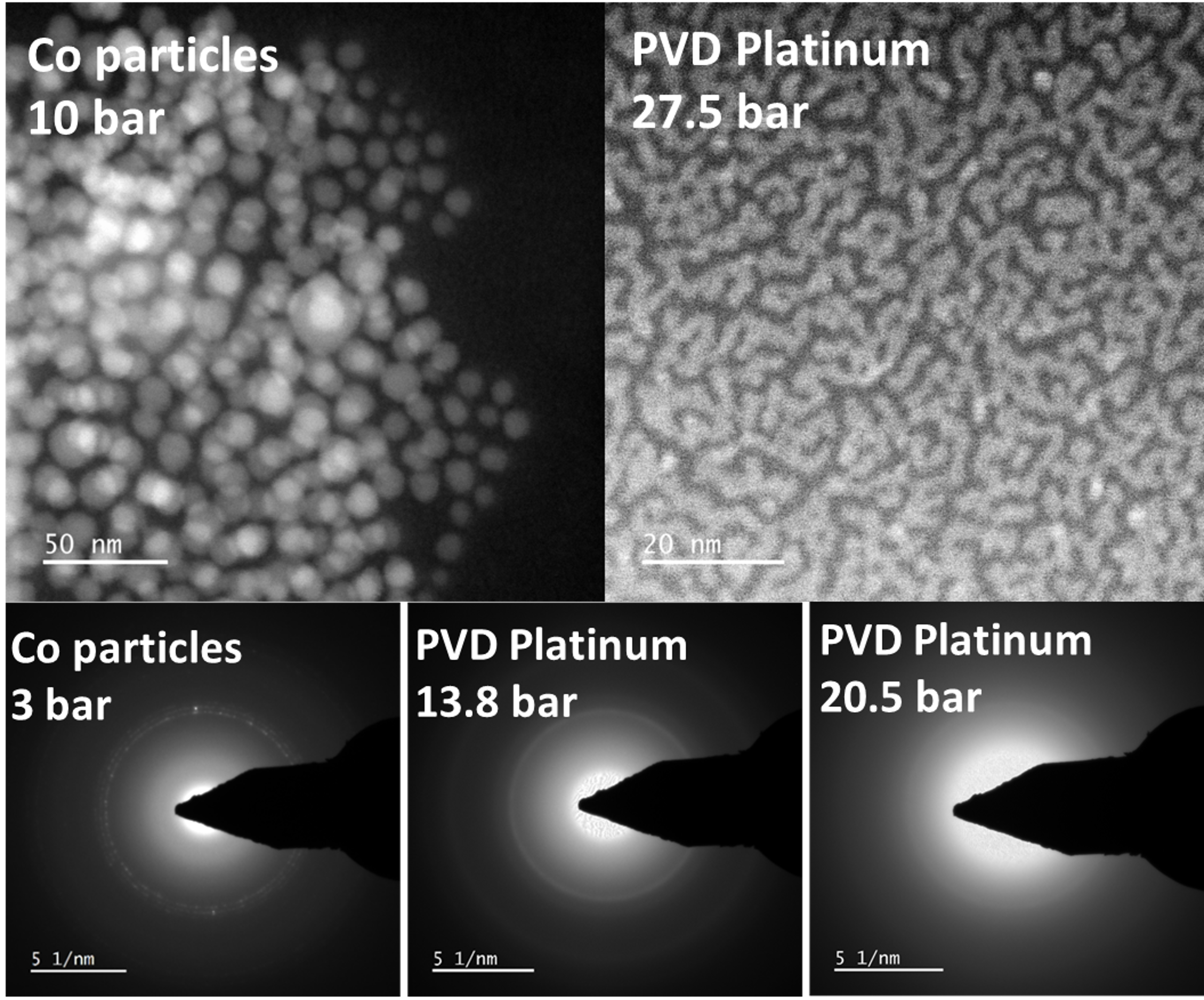
In-situ TEM high-pressure gas flow sample holder – 1.5 nm resolution at 27.5 bar N2
Imaging and diffraction of supported nanostructures under high-pressure gas cell transmission electron microscopy (TEM) was demonstrated with supported nanostructures.
- High-pressure gas cell integrity was demonstrated up to 30 bar of N2.
- Resolution of ~1.5 nm was achieved using deposited Pt islands at a broad range of pressures up to 27.5 bar of N2.
- Useful SAED patterns with distinguishable rings were also obtained at 3 bar N2 for Co nanoparticles and up to 20 bar for deposited Pt.
Reference: George Hollyer, et al, MRS Commun. 15, 898-905 (2025) DOI: 10.1557/s43579-025-00825-7
Image copyright © 2025 Springer Nature Limited

High-temperature gas heterogeneous catalysis
Investigate catalyst restructuring and evolution under reactive gas environments at elevated temperatures.
High-temperature gas heterogeneous catalysis
Morphological/chemical restructuring of catalyst particles in high temperature gases
Au0.75Pd0.25 catalyst nanoparticle evolution was analyzed using in-situ scanning transmission electron microscopy (STEM) with high-resolution energy dispersive X-ray spectroscopy (EDS) and electron energy loss spectroscopy (EELS).
- Air and O2 at 400 °C led to sharpening of the facets of particles, with small areas of segregated Pd.
- At 200 °C, CO exposure led to the loss of facets, while H2 exposure at 400 °C led to subtle increases to surface roughness.
- DFT calculations suggest that PdO reduction to Pd causes smaller facets and rougher edges.
Reference: Alexandre C. Foucher, et al, J. Phys. Chem. C 126 (42) (2022) 18047-18056 (2022) DOI:10.1021/acs.jpcc.2c05929
Image copyright © 2022 American Chemical Society.

In-situ gas heterogeneous catalyst performance
Study the relationship between catalyst evolution and performance under realistic gas-phase reaction conditions.
In-situ gas heterogeneous catalyst performance
Cu-Ir nanoshells remain stable, catalytically efficient at high temperature
Ir nanoshells derived from core-shell Cu-Ir catalyst nanoparticles were characterized during high-temperature oxygen reduction and oxygen evolution reactions under scanning transmission electron microscopy with energy dispersive X-ray spectroscopy (STEM-EDS).
- Remarkable stability of the thick Ir-shells was demonstrated under O2 and H2 environments up to 800 °C.
- A higher mass activity was measured for both the thick and thin Ir shells compared to both the core-shell Cu-Ir particles and a commercially available Pt-based catalyst.
- XAS revealed residual Cu remaining inside the shells after oxidation, which helps to rationalize the trend in catalytic activity.
Reference: Alexandre C. Foucher, et al, Chem. Mater. 35 (11) 4572-4580 (2023) DOI: 10.1021/acs.chemmater.3c00970
Image copyright © 2023 American Chemical Society

In-situ oxidation and reduction of heterogeneous catalysts
Investigate reversible oxidation, reduction, and phase transformations in heterogeneous catalysts.
In-situ oxidation and reduction of heterogeneous catalysts
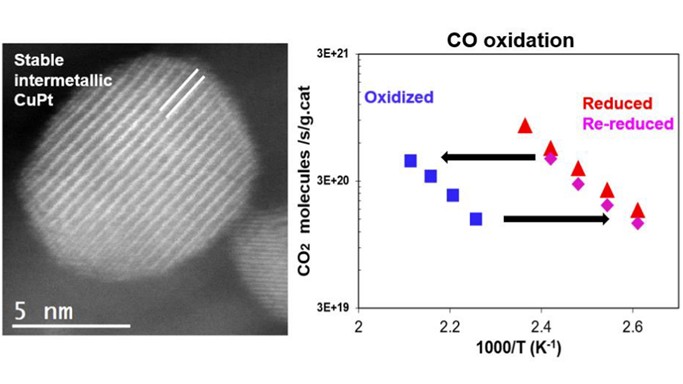
Cu-Pt nanospheres form stable, catalytically active intermetallic at 800 °C
Cu-Pt catalyst nanoparticles were characterized using in-situ scanning transmission electron microscopy (STEM) with high-resolution energy dispersive X-ray spectroscopy (EDS) and electron energy loss spectroscopy (EELS) during H2 and O2 gas treatments.
- Core-shell Cu-Pt particles were stable at 400 °C, with the Pt-rich layer protecting the Cu core from oxidation.
- 800 °C annealing caused a transformation into an intermetallic CuPt phase with O2 oxidation fully reversible by H2 reduction.
- Stability and reversibility of catalytic degradation of CuPt nanostructures may help to reduce catalyst cost by reducing Pt content requirement.
Reference: Alexandre C. Foucher, et al, J. Am. Chem. Soc. 145 (9) 5410-5421 (2023) DOI: 10.1021/jacs.2c13666
Imagecopyright © 2023 American Chemical Society

Correlative in-situ heterogeneous catalysis
Correlate catalyst structure, chemistry, and performance using complementary in situ electron and X-ray microscopy techniques.
Correlative in-situ heterogeneous catalysis
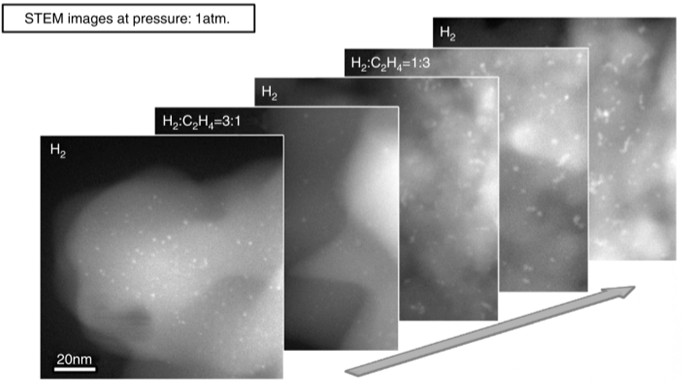
In-situ multi-modal tracking of catalytic reactions in supported Pt catalysts
Heterogeneous catalyst transformations were characterized using correlated gas cell scanning transmission electron microscopy (STEM) and X-ray microscopy and X-ray absorption spectroscopy (XAS) under ethylene hydrogenation conditions.
- Catalytic activity of supported Pt catalysts was measured by in-situ XAS relative to cluster size fraction dynamics obtained via in-situ TEM.
- The multi-modal capability of the Hummingbird Scientific gas cell to be transferred between the TEM and X-Ray microscope allowed a variety of probes to characterize the same model catalytic reaction.
Reference: Y. Li, et al, Nature Communications 6 7583 (2015)
Alexandre C. Foucher, et al, J. Am. Chem. Soc. 145 (9) 5410-5421 (2023) DOI: 10.1021/jacs.2c13666
Image copyright © 2015 Springer Nature Limited

Correlative operando electrocatalysis
Correlate electrocatalyst structure, chemistry, and performance using complementary in situ electron and X-ray microscopy techniques.
Correlative operando electrocatalysis
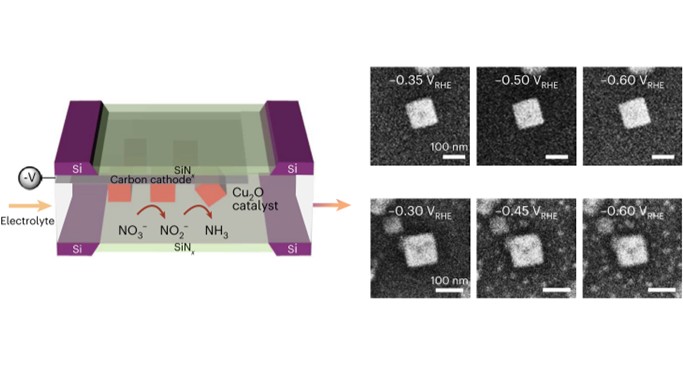
Nanocube catalyst microstructural evolution during nitrate reduction reaction
Cu2O nanocube catalyst restructuring and chemical changes under the nitrate reduction reaction (NO3RR) were characterized in-situ using liquid electrochemical transmission electron microscopy (EC-TEM) correlated to liquid electrochemical transmission X-ray microscopy (EC-TXM). Ex-situ TEM imaging of the nanocubes was performed using the TEM tomography sample holder.
- Nanocubes evolved under NO3RR in distinct catalyst motifs that depend on the applied potential and chemical environment.
- Cu2O was stabilized alongside metallic copper for extended durations at -0.6 VRHE due to surface hydroxide formation, boosting ammonia selectivity.
- Time-resolved spectroscopy allowed morphological evolution to be linked to catalytic mechanisms under operating conditions
Reference: Aram Yoon, et al, Nature Materials 24 762-769 (2025) DOI: 10.1038/s41563-024-02084-8
Image copyright © 2025, The Author(s). Published by Springer Nature Limited. This article is licensed under CC-BY 4.0.
High-pressure gas heterogeneous catalysis
Observe catalyst structure and reaction dynamics under industrially relevant high-pressure gas environments.
High-temperature gas heterogeneous catalysis
Investigate catalyst restructuring and evolution under reactive gas environments at elevated temperatures.
In-situ gas heterogeneous catalyst performance
Study the relationship between catalyst evolution and performance under realistic gas-phase reaction conditions.
In-situ oxidation and reduction of heterogeneous catalysts
Investigate reversible oxidation, reduction, and phase transformations in heterogeneous catalysts.
Correlative in-situ heterogeneous catalysis
Correlate catalyst structure, chemistry, and performance using complementary in situ electron and X-ray microscopy techniques.
Correlative operando electrocatalysis
Correlate electrocatalyst structure, chemistry, and performance using complementary in situ electron and X-ray microscopy techniques.
Browse publications
Nano Letters
Applied Catalysis B: Environment and Energy
Journal of Hazardous Materials
ChemRxiv
Research Spotlight
Video showing ferrihydrite nanoparticle fragmentation and restructuring during a phase transformation into magnetite in a heated gaseous environment.
In-situ high-temperature ferrihydrite reduction in H₂ gas
Although ferrihydrites do not typically catalyze reactions in gaseous environments, multiple transient Fe-based heterogeneous catalysts such as magnetite can be produced by activation of ferrihydrite nanoparticles via hydrogen reduction, with a strong dependence on applied conditions. The TEM Gas Heating holder enables direct connection of applied pressure, temperature, and beam conditions to transient nanocatalyst formation dynamics.
The video shows ferrihydrite nanoparticle reduction to fragmented magnetite in 1.1 bar of hydrogen gas flown into the TEM gas cell. The imaging stability across the temperature range enabled real-time grain restructuring and phase changes of particles from amorphous to a crystalline structure to be captured as the particle was reduced when heated to 360°C in the presence of H2.
Hummingbird Advantage
- Resolution at temperature and pressure nearly match vacuum imaging performance
- Drift at temperature matches room temperature TEM drift spec – no need for drift correction software
Reference: Hummingbird Scientific internal data in collaboration with Jaco Olivier, Matthew Coombes, and Jan Neethling from Nelson Mandela Metropolitan University, South Africa
Why choose Hummingbird Scientific for your research?
Hummingbird Scientific supports in situ and operando catalysis research with flexible microscopy platforms, customizable sample chips, direct scientist support, internal TEM lab expertise, and in-house engineering and manufacturing capabilities.
Broader options for in situ catalysis experiments
Catalysis research involves gas reactions, liquid-phase chemistry, electrocatalysis, thermal activation, environmental control, or combined sample conditions. Hummingbird supports these workflows with in situ microscopy platforms for TEM, SEM, and X-ray microscopy, including gas, liquid, heating, biasing, and electrochemical experiment configurations. This gives researchers more ways to match the instrument setup to the reaction environment and measurement goal.
More chip choices for experimental flexibility
Microfabricated chip design determines what can be observed and measured during an in situ catalysis experiment. Through our dedicated microfabrication division, Hummingbird supports standard and custom chips for heating, gas cell TEM, liquid cell TEM, electrochemistry, biasing, spacer thickness, window geometry, electrode layout, and specialized sample environments. This lets researchers match the chip layout to the catalyst, reaction environment, and measurement goal.
Scientist support backed by an internal TEM Lab
Catalysis researchers work directly with scientists and technical staff who understand the practical details of in situ and operando TEM workflows. Hummingbird’s internal TEM Lab allows our team to evaluate microscope-facing performance during development, including alignment, handling, imaging stability, sample-environment behavior, and workflow usability under real TEM conditions.
Engineering, production, and custom capability
Hummingbird's in-house capabilities connect engineering, microfabrication, manufacturing, assembly, calibration, and testing within one development process. For catalysis research, that means standard products can be supported by custom chips and holder configurations, and application-specific workflow changes when the experiment requires something more specific.
High-pressure gas heterogeneous catalysis
Observe catalyst structure and reaction dynamics under industrially relevant high-pressure gas environments.
High-pressure gas heterogeneous catalysis
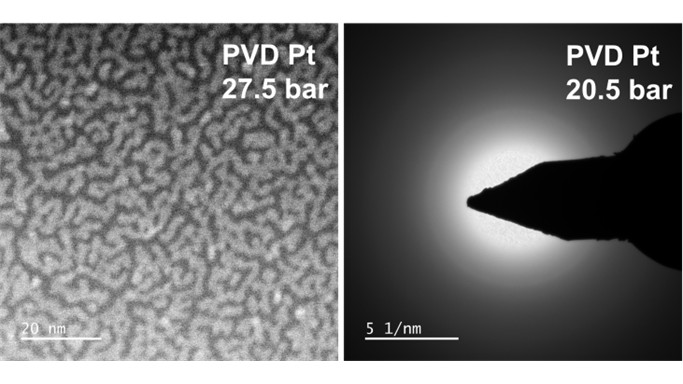
In-situ TEM high-pressure gas flow sample holder – 1.5 nm resolution at 27.5 bar N2
Imaging and diffraction of supported nanostructures under high-pressure gas cell transmission electron microscopy (TEM) was demonstrated with supported nanostructures.
- High-pressure gas cell integrity was demonstrated up to 30 bar of N2.
- Resolution of ~1.5 nm was achieved using deposited Pt islands at a broad range of pressures up to 27.5 bar of N2.
- Useful SAED patterns with distinguishable rings were also obtained at 3 bar N2 for Co nanoparticles and up to 20 bar for deposited Pt.
Reference: George Hollyer, et al, MRS Commun. 15, 898-905 (2025) DOI: 10.1557/s43579-025-00825-7
Image copyright © 2025 Springer Nature Limited
High-temperature gas heterogeneous catalysis
Investigate catalyst restructuring and evolution under reactive gas environments at elevated temperatures.
High-temperature gas heterogeneous catalysis
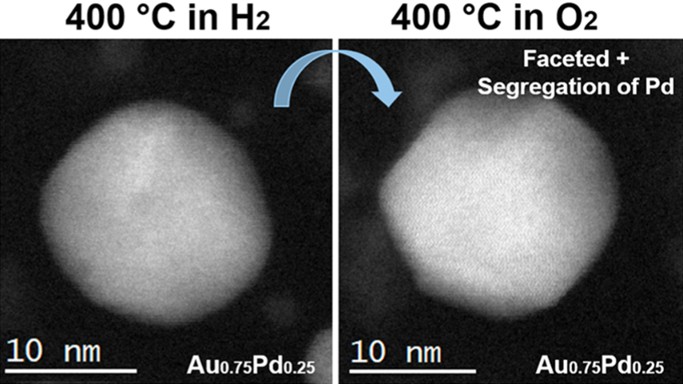
Morphological/chemical restructuring of catalyst particles in high temperature gases
Au0.75Pd0.25 catalyst nanoparticle evolution was analyzed using in-situ scanning transmission electron microscopy (STEM) with high-resolution energy dispersive X-ray spectroscopy (EDS) and electron energy loss spectroscopy (EELS).
- Air and O2 at 400 °C led to sharpening of the facets of particles, with small areas of segregated Pd.
- At 200 °C, CO exposure led to the loss of facets, while H2 exposure at 400 °C led to subtle increases to surface roughness.
- DFT calculations suggest that PdO reduction to Pd causes smaller facets and rougher edges.
Reference: Alexandre C. Foucher, et al, J. Phys. Chem. C 126 (42) (2022) 18047-18056 (2022) DOI:10.1021/acs.jpcc.2c05929
Image copyright © 2022 American Chemical Society.
In-situ gas heterogeneous catalyst performance
Study the relationship between catalyst evolution and performance under realistic gas-phase reaction conditions.
In-situ gas heterogeneous catalyst performance
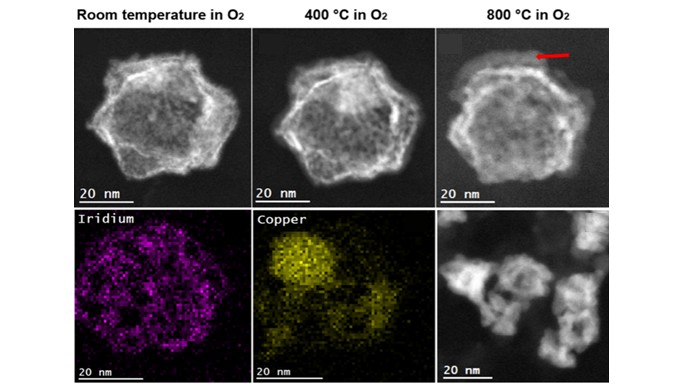
Cu-Ir nanoshells remain stable, catalytically efficient at high temperature
Ir nanoshells derived from core-shell Cu-Ir catalyst nanoparticles were characterized during high-temperature oxygen reduction and oxygen evolution reactions under scanning transmission electron microscopy with energy dispersive X-ray spectroscopy (STEM-EDS).
- Remarkable stability of the thick Ir-shells was demonstrated under O2 and H2 environments up to 800 °C.
- A higher mass activity was measured for both the thick and thin Ir shells compared to both the core-shell Cu-Ir particles and a commercially available Pt-based catalyst.
- XAS revealed residual Cu remaining inside the shells after oxidation, which helps to rationalize the trend in catalytic activity.
Reference: Alexandre C. Foucher, et al, Chem. Mater. 35 (11) 4572-4580 (2023) DOI: 10.1021/acs.chemmater.3c00970
Image copyright © 2023 American Chemical Society
In-situ oxidation and reduction of heterogeneous catalysts
Investigate reversible oxidation, reduction, and phase transformations in heterogeneous catalysts.
In-situ oxidation and reduction of heterogeneous catalysts
Cu-Pt nanospheres form stable, catalytically active intermetallic at 800 °C
Cu-Pt catalyst nanoparticles were characterized using in-situ scanning transmission electron microscopy (STEM) with high-resolution energy dispersive X-ray spectroscopy (EDS) and electron energy loss spectroscopy (EELS) during H2 and O2 gas treatments.
- Core-shell Cu-Pt particles were stable at 400 °C, with the Pt-rich layer protecting the Cu core from oxidation.
- 800 °C annealing caused a transformation into an intermetallic CuPt phase with O2 oxidation fully reversible by H2 reduction.
- Stability and reversibility of catalytic degradation of CuPt nanostructures may help to reduce catalyst cost by reducing Pt content requirement.
Reference: Alexandre C. Foucher, et al, J. Am. Chem. Soc. 145 (9) 5410-5421 (2023) DOI: 10.1021/jacs.2c13666
Imagecopyright © 2023 American Chemical Society
Correlative in-situ heterogeneous catalysis
Correlate catalyst structure, chemistry, and performance using complementary in situ electron and X-ray microscopy techniques.
Correlative in-situ heterogeneous catalysis
In-situ multi-modal tracking of catalytic reactions in supported Pt catalysts
Heterogeneous catalyst transformations were characterized using correlated gas cell scanning transmission electron microscopy (STEM) and X-ray microscopy and X-ray absorption spectroscopy (XAS) under ethylene hydrogenation conditions.
- Catalytic activity of supported Pt catalysts was measured by in-situ XAS relative to cluster size fraction dynamics obtained via in-situ TEM.
- The multi-modal capability of the Hummingbird Scientific gas cell to be transferred between the TEM and X-Ray microscope allowed a variety of probes to characterize the same model catalytic reaction.
Reference: Y. Li, et al, Nature Communications 6 7583 (2015)
Alexandre C. Foucher, et al, J. Am. Chem. Soc. 145 (9) 5410-5421 (2023) DOI: 10.1021/jacs.2c13666
Image copyright © 2015 Springer Nature Limited
Correlative operando electrocatalysis
Correlate electrocatalyst structure, chemistry, and performance using complementary in situ electron and X-ray microscopy techniques.
Correlative operando electrocatalysis
Nanocube catalyst microstructural evolution during nitrate reduction reaction
Cu2O nanocube catalyst restructuring and chemical changes under the nitrate reduction reaction (NO3RR) were characterized in-situ using liquid electrochemical transmission electron microscopy (EC-TEM) correlated to liquid electrochemical transmission X-ray microscopy (EC-TXM). Ex-situ TEM imaging of the nanocubes was performed using the TEM tomography sample holder.
- Nanocubes evolved under NO3RR in distinct catalyst motifs that depend on the applied potential and chemical environment.
- Cu2O was stabilized alongside metallic copper for extended durations at -0.6 VRHE due to surface hydroxide formation, boosting ammonia selectivity.
- Time-resolved spectroscopy allowed morphological evolution to be linked to catalytic mechanisms under operating conditions
Reference: Aram Yoon, et al, Nature Materials 24 762-769 (2025) DOI: 10.1038/s41563-024-02084-8
Image copyright © 2025, The Author(s). Published by Springer Nature Limited. This article is licensed under CC-BY 4.0.
Featured products





Frequently asked questions
Ready to discuss your experiment?
Talk with an applications scientist to identify the right products for your experiment and request a quote.