Multichannel Gas Control Software for In Situ Microscopy
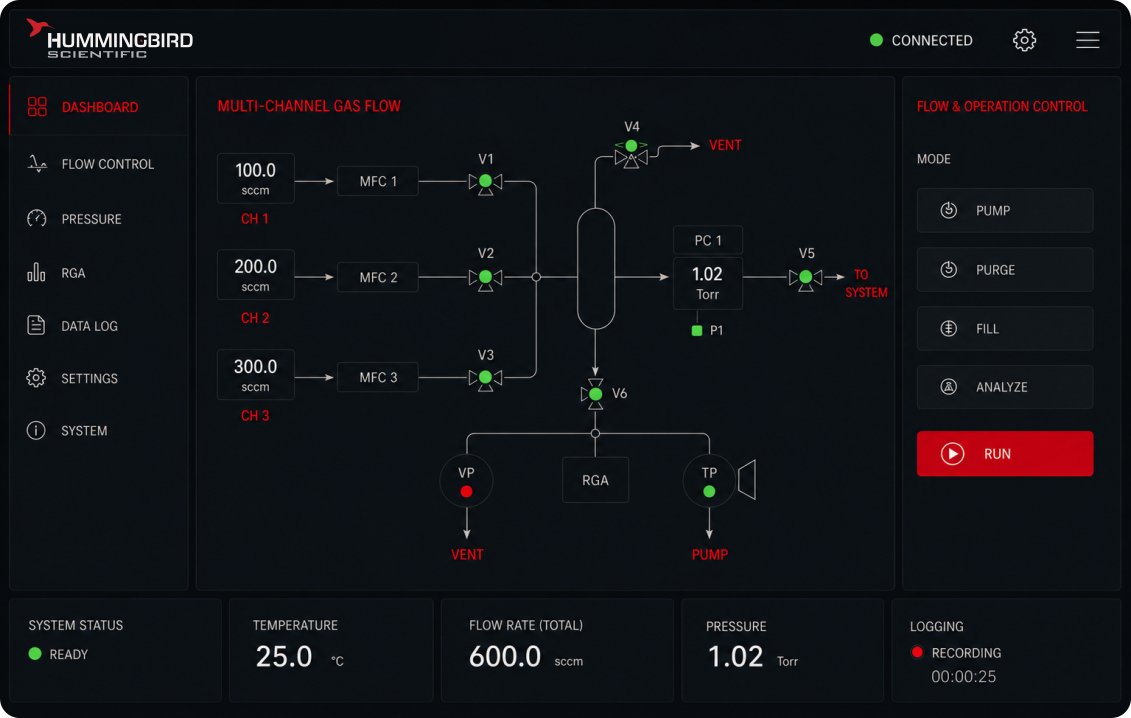

Precisely control and mix multiple gases in real time to create complex, reproducible experimental environments.
Hummingbird Scientific’s Multichannel Gas Delivery Software enables precise control of multiple gas inputs during in situ electron microscopy experiments. Users can independently manage gas channels, adjust pressure, and dynamically control environmental conditions in real time.
Designed for multichannel Gas TEM holders, the software supports gas mixing, switching, and sequential exposure, allowing researchers to study material behavior under varying gas compositions and controlled reaction environments.
Why Researchers Choose Hummingbird Scientific
Hummingbird Scientific’s multichannel gas control software is purpose-built for in-situ microscopy, providing a level of environmental control that is difficult to achieve with generic systems.
The software is tightly integrated with Hummingbird multichannel gas holders and controllers, enabling reliable communication and precise coordination between gas inputs and experimental conditions. This allows researchers to create stable or dynamically changing gas environments with confidence.
With support for independent channel control, real-time monitoring, and repeatable experiment execution, the platform enables both straightforward gas exposure studies and more advanced multi-step or multi-gas experiments.
Software Features
Multi-Channel Gas Control and Automation
The software provides independent control over multiple gas channels, allowing users to adjust flow or pressure conditions for each channel individually.
Researchers can introduce, modify, or switch between gases during an experiment, enabling dynamic control of the sample environment. Experiments can be started, paused, or adjusted in real time, allowing precise control over gas exposure conditions without interrupting the workflow.
The system supports both manual adjustments and automated control, enabling users to maintain stable gas environments or execute predefined changes in gas composition and flow.
Flexible Gas Control Modes
The software supports flexible operation modes that enable both stable and dynamic gas environments.
Users can maintain constant pressure or flow conditions, switch between gas channels, or vary conditions over time depending on experimental needs. These modes support both steady-state experiments and time-dependent studies involving changes in gas composition.
This flexibility allows researchers to simulate realistic environmental conditions and study material behavior under varying gas exposure scenarios.
Multi-Gas Mixing and Channel Switching
The software enables precise control of multiple gas inputs, allowing users to mix gases or switch between channels during an experiment.
This capability allows researchers to create complex gas environments, including controlled mixtures and sequential exposure to different gases. Gas composition can be adjusted in real time, making it possible to simulate reaction pathways, introduce reactive species, or study stepwise processes.
By supporting both simultaneous multi-gas delivery and controlled switching between channels, the software enables experiments that go beyond single-gas environments, providing greater flexibility and experimental depth.
Real-Time Gas Environment Monitoring
The software continuously monitors system conditions and displays real-time data during experiments.
Parameters such as pressure and gas behavior are visualized through live plots, allowing users to observe changes in the environment as they occur. This enables immediate identification of transitions, stabilization periods, and system response during gas exposure.
Interactive graph tools allow users to zoom, pan, and analyze both recent activity and full experimental history without interrupting ongoing experiments.
Integrated with Hummingbird Gas TEM Systems
The software is designed to work directly with Hummingbird Scientific multichannel gas controllers and TEM holders.
This integration ensures reliable communication, accurate gas control, and consistent system performance. The software provides clear feedback on system status, allowing users to confidently manage gas delivery throughout the experiment.
Because the software and hardware are designed together, setup is streamlined and experiments can be conducted with minimal configuration.
Gas Environment Data Collection and Analysis
The software records pressure and system data as a function of time throughout each experiment, providing a complete record of gas conditions and system behavior.
What data does the software collect?
The software records pressure and time-based system data for each gas channel during the experiment.
How is the data displayed?
Data is displayed in real time as live plots, allowing users to monitor both current conditions and historical trends.
How can data be exported?
Data can be exported in CSV format for analysis in external tools, and graphs can be saved as image files for reporting.
How is data managed?
Users can reset, save, and organize experimental data within each session, allowing multiple experiments to be conducted and compared efficiently.
Frequently Asked Questions:
Compatible Specimen Holders
Supported Manufacturers


.jpg)