
Your data, your workflow
Colibri Platform™ supports an open approach to data management for in situ microscopy, giving laboratories the freedom to use their experimental data across the software and data environments chosen for their research, without tying the workflow to a single vendor-specific system.
Laboratories can use that data in OEM microscope software, Python and open-source analysis workflows, facility databases, LIMS or ELN platforms, institutional repositories, and customer-selected automation or AI environments.
Rather than requiring a separate proprietary data environment, Colibri Platform™ supports workflows that keep laboratories in control of where their data is analyzed, managed, archived, and reused. This gives researchers and facilities flexibility to build around their experiments, existing infrastructure, and future needs instead of adapting their work to the limits of one closed ecosystem.
Open data management, not a closed data environment
Colibri Platform™ supports experimental-data workflows that work with the software and systems a laboratory chooses, rather than requiring data to remain inside one vendor-specific environment.
Connect experiment data with institutional systems
Open data workflows make it easier to use Hummingbird experimental data within the LIMS, ELN, repositories, and facility systems your institution already manages.
Explore LIMS and Institutional Data
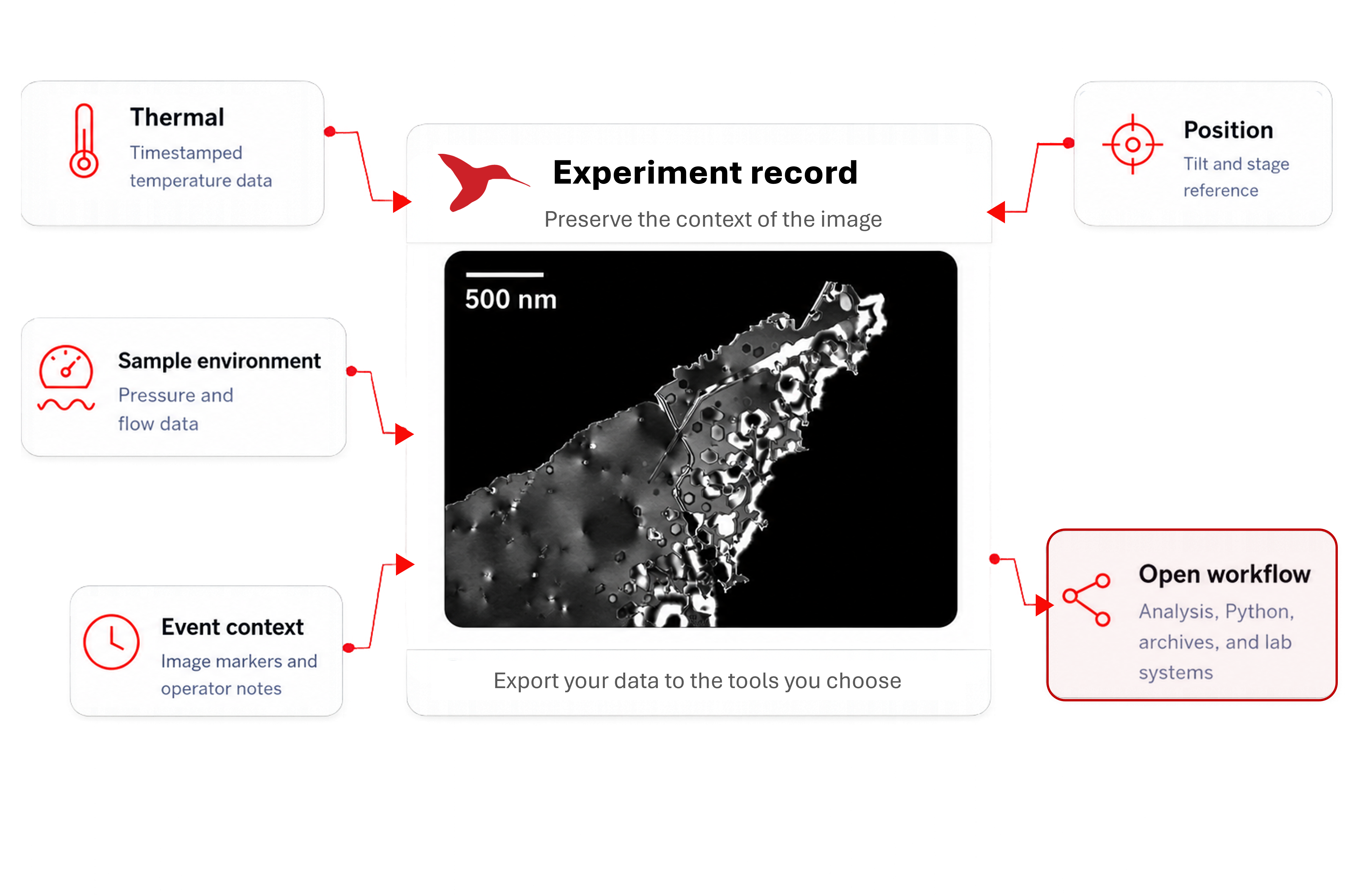
What is an in-situ experiment record?
An in situ experiment record is a structured account of what happened during an experiment. Images, videos, spectra, diffraction patterns, and other microscope data are created under changing physical conditions that may affect how the results are interpreted.
The record may include commanded and measured values, hardware states, timestamps, alarms, notes, identifiers, calibration information, and references to acquired files.
No single source necessarily contains the complete record. Depending on the product and workflow, information may come from Hummingbird Control™, microscope or OEM acquisition software, operator input, and customer-selected data systems.
The image shows what happened. The experiment record helps explain why.
Information that may form part of the record:
Data formats and integration pathways
Data fields, export formats, and integration pathways vary by Hummingbird product and configuration. Product pages and technical documentation identify the capabilities supported by each system.
Currently available
Product-specific CSV logs where supported.
Supported or project-specific
Customer- or OEM-specific exports, file references, handoff workflows, and defined software integrations.
Future direction
JSON experiment records, HDF5/Zarr-compatible exports, and PDF experiment summaries.
Relating experimental-state data to microscope data
The appropriate method depends on the systems involved and the required level of coordination.
Manual comparison
Users can compare supported Hummingbird logs with microscope files using acquisition times, operator notes, file names, or other references.
Timestamp and identifier alignment
Where both systems provide usable timestamps, session identifiers, or file references, these fields can help relate experimental-state data to microscope data.
Supported or project-specific integration
For defined configurations, Hummingbird Connect™ may support coordinated data exchange or a project-specific workflow pathway. Support depends on the OEM environment, microscope model, software version, Hummingbird system, available interfaces, and project requirements.
Experimental context for AI workflows
Image-only models may identify patterns without knowing the conditions that produced them. Temperature, pressure, electrical state, position, timing, calibration, alarms, and operator actions can provide important context for customer-selected analysis, automation, and AI environments.
For adaptive experiments, external software may also need to determine what the hardware is doing, whether a command succeeded, and whether the observed response matches the intended state.
Discuss your data management workflow
Share your software requirements, automation goals, and microscopy workflows to receive recommended control, integration, and data management solutions.