LIMS-Ready Data for In-Situ TEM and SEM
Preserve experimental context for your institution’s LIMS, ELN, repository, or data workflow.
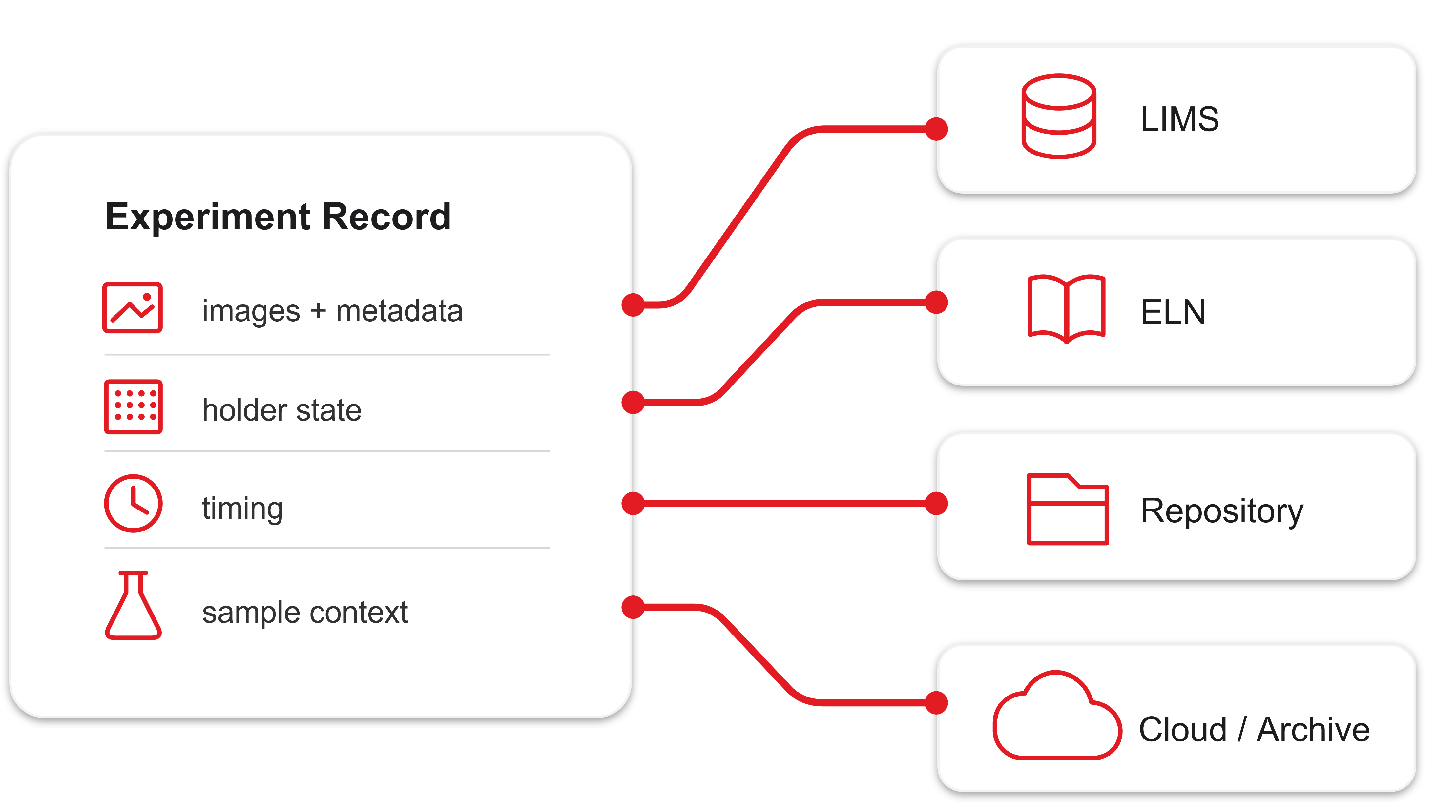

A microscopy experiment produces more than files
Modern TEM, STEM, and SEM experiments may produce images, spectra, detector data, microscope settings, sample information, controller records, environmental conditions, timestamps, user notes, and facility context.
For in-situ microscopy, the physical conditions acting on the sample may be as important as the image itself. Temperature, pressure, gas composition, liquid flow, voltage, current, holder state, stage position, calibration, and timing can all affect how the result should be interpreted.
A useful experiment record connects those conditions to the appropriate microscope session, sample, acquired dataset, and institutional record. When that information remains divided among files, folders, screenshots, and notebooks, the experiment becomes harder to reconstruct, search, compare, share, and reuse.
The goal is not simply to store more data. It is to preserve the relationships that make the experiment understandable.
What does a LIMS do?
A laboratory information management system, or LIMS, helps an institution manage information across the research lifecycle. Depending on the system, that may include:
- Users, proposals, projects, and permissions
- Samples, materials, and experiment identifiers
- Instruments, reservations, and facility records
- Files, metadata, storage, and retrieval
- Reporting, compliance, and long-term access
Some laboratories use commercial LIMS platforms. Others use electronic laboratory notebooks, institutional repositories, shared servers, cloud services, scientific data platforms, or custom databases. Many facilities use several of these systems together.
Hummingbird does not need to duplicate that infrastructure. Its role is to make the state of the Hummingbird system and sample environment easier to associate with the microscope session, sample, acquired data, and institutional record.
What belongs in an in-situ microscopy experiment record?
A useful in-situ microscopy record may connect:
- Session, operator, project, and facility identifiers
- Microscope, detector, holder, controller, sample, and chip identifiers
- Image, spectrum, diffraction, and detector timestamps
- Microscope and acquisition conditions
- Temperature, pressure, gas composition, and flow
- Liquid flow and electrochemical conditions
- Voltage, current, resistance, and electrical state
- Commanded values and measured values
- Holder, stage, mechanical, or environmental state
- Stage position, tilt, and motion where available
- Calibration versions and relevant system configuration
- Alarms, interlocks, errors, and manual interventions
- User notes, sample history, and experiment events
- File locations, export information, and data provenance
The specific information available depends on the Hummingbird product, microscope environment, software configuration, and project scope.
Even when every element cannot be combined into one file, consistent identifiers and timing can help researchers connect the records and reconstruct the experiment across customer-selected systems.
What does LIMS-ready microscopy data mean?
LIMS-ready does not necessarily mean that a finished connector exists for every laboratory information management system. It means that the relevant experimental information is prepared for responsible handoff.
Identifiable
The record can be associated with the correct session, sample, holder, controller, chip, instrument, and calibration.
Time-aware
The record includes enough timing information to place system states and experimental events within the correct sequence.
Synchronized
Where supported, changes in the holder or sample environment can be related to microscope acquisition, images, spectra, or other measurements.
Structured
The information is organized in a documented form rather than preserved only in screenshots, filenames, or operator memory.
Exportable
Verified product capabilities allow relevant information to be used outside the original Hummingbird Control™ interface.
Traceable
The record retains information about its source, configuration, calibration, files, and experimental history.
This structure can support search, comparison, troubleshooting, publication, archiving, reuse, automation, and future AI workflows.
How Hummingbird supports the data handoff
Colibri Platform™ is Hummingbird Scientific’s open software and data platform for in-situ microscopy.
Hummingbird Control™ operates and monitors supported Hummingbird hardware and the physical conditions applied to the sample. Depending on the product, it may also record or export controller values, system states, timestamps, alarms, and other experimental information.
Hummingbird Connect™ supports verified and project-specific pathways between Hummingbird systems and microscope-manufacturer, facility, or customer software environments.
Available records, exports, and interfaces vary by product and project. Hummingbird can help determine whether a requirement can be met through an existing product capability, a documented data handoff, customer-side tools, or project-specific development.
Available product capabilities
Each Hummingbird system has product-specific control, monitoring, logging, and data-export capabilities. Control Software pages identify the parameters that can be monitored or recorded, the information that can be exported, and the functions currently supported for each hardware and software configuration.
Project-specific pathways
Hummingbird can discuss requirements involving timing alignment, experiment identifiers, structured exports, OEM software environments, institutional systems, Python workflows, and custom research infrastructure.
Future direction
Future Colibri Platform™ development is focused on more consistent experiment identities, timestamps, state records, synchronization, provenance, and portable data handoff across Hummingbird systems.
Together, these capabilities can make in-situ microscopy data more useful for facility-scale data management, advanced automation, and AI-assisted research without requiring those workflows to operate inside a Hummingbird-only environment.
Built for the data system your institution chooses
Laboratories should be free to use the data environment that best supports their research.
That may include:
- Commercial or open-source LIMS platforms
- Electronic laboratory notebooks
- Institutional repositories
- OEM microscope software
- Local servers and shared file systems
- Cloud and high-performance computing environments
- Python and Jupyter workflows
- Open-source microscopy tools
- Custom laboratory databases and analysis pipelines
Hummingbird does not require the laboratory to replace those systems. Colibri Platform™ supports a customer-defined workflow in which Hummingbird operates and describes the physical experiment while the institution retains control of storage, analysis, reporting, governance, and long-term data stewardship.
The laboratory decides where its data belongs.
Why experiment context matters
More complete microscopy records make experiments easier to interpret, reproduce, troubleshoot, compare, publish, archive, and reuse. They also give automation and AI workflows the experimental context needed to connect each measurement with the physical conditions that produced it.
Complete experiment context can help laboratories:
- Reconstruct experiments without relying on operator memory
- Relate image changes to sample-environment conditions
- Compare sessions, samples, and system configurations
- Improve facility support, training, and troubleshooting
- Prepare more complete publication and archive records
- Build a stronger foundation for future automation and AI
An image may show what happened. Experimental context helps explain why, when, and under which conditions it occurred.
Metadata-ready records are therefore an important first step toward AI-ready microscopy. Explore how structured experimental context can support human-in-the-loop automation, coordinated workflows, and future AI-guided experiments.
Research data infrastructure references
NIST NexusLIMS
https://pages.nist.gov/NexusLIMS/
A microscopy-focused laboratory information management system that harvests instrument data and creates structured experiment records.
NIST NexusLIMS-CDCS
https://github.com/usnistgov/NexusLIMS-CDCS
A browser-based interface for accessing and managing structured NexusLIMS experiment records.
NIST MDCS (Materials Data Curation System)
https://www.nist.gov/programs-projects/materials-data-curation-system
XML-based platform for structured materials data curation, transformation, and sharing.
NIST CDCS (Configurable Data Curation System)
https://www.nist.gov/programs-projects/configurable-data-curation-system-cdcs
General-purpose, FAIR-oriented data curation platform supporting schemas, interoperability, APIs, and modular systems.
NIST Research Data Framework (RDaF) 2.0
https://www.nist.gov/publications/nist-research-data-framework-rdaf-version-20
Customizable framework for building research data management strategies across the data lifecycle.
NIST Materials Resource Registry (MRR / NMRR)
https://www.nist.gov/programs-projects/nist-materials-resource-registry
Registry for discovering materials data resources, with metadata, interoperability, and API/web-service concepts.
MaRDA FAIR Materials Microscopy & LIMS Recommendations
https://link.springer.com/article/10.1557/s43577-025-00882-2
Community best-practice recommendations for FAIR microscopy data, metadata standards, and LIMS usage.
4CeeD (Timely & Trusted Curation and Coordination)
https://4ceed.github.io/
Open-source ecosystem for uploading, extracting, organizing, and curating scientific data and metadata.
Discuss your facility data requirements
Tell us which microscope, Hummingbird system, software environment, institutional data system, and experimental record you are planning. Our team can help identify available capabilities and determine whether a documented or project-specific handoff pathway is appropriate.
Frequently asked questions
Related Colibri Platform™ Pages
Explore how Colibri supports open, structured, and portable in-situ TEM data workflows:
- Colibri Platform™
- Hummingbird Control™ Software
- Hummingbird Connect™ OEM Integration
- In-Situ Experiment Data Management
- AI Ready TEM, STEM, and SEM Workflows
- The Future of Open Microscopy