Gas Heating Control Control Software for In Situ Microscopy
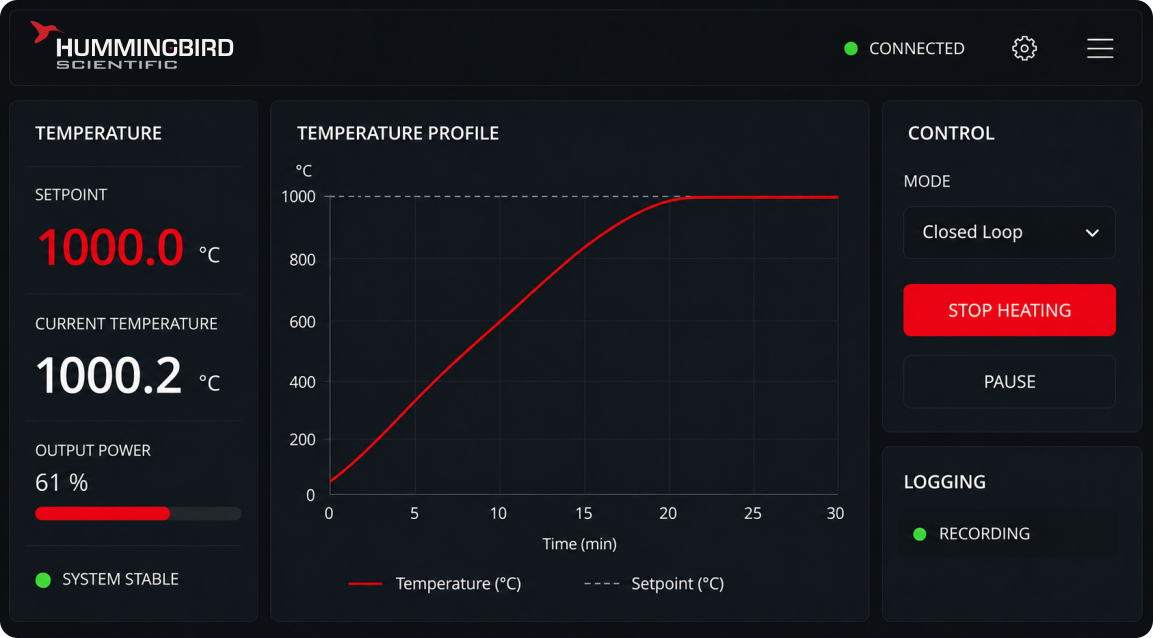

Control temperature precisely, monitor experiments in real time, and capture high-quality data all in one integrated platform.
Hummingbird Scientific's Gas TEM Control Software provides automated gas delivery, precision pressure control, purge management, real-time monitoring, and data logging for in-situ Transmission Electron Microscopy (TEM) experiments. Designed specifically for Gas TEM holders, the software enables researchers to create controlled environmental conditions for studying dynamic material behavior at the nanoscale.
Whether investigating catalytic reactions, oxidation and reduction processes, nanoparticle growth, energy materials, or gas-solid interactions, the software delivers the stability, repeatability, and ease of use required for advanced environmental TEM research.
Why Researchers Choose Hummingbird Scientific
Hummingbird Scientific’s gas heating software is designed specifically for in-situ electron microscopy applications, ensuring accurate control and reliable performance.
Unlike generic control software, it is tightly integrated with Hummingbird hardware, allowing precise communication between controller and sample holder. This results in stable temperature control, reduced setup complexity, and improved experimental consistency.
The software also includes built-in calibration workflows, real-time visualization, and automated experiment modes, enabling both routine experiments and advanced thermal studies without additional tools or software.
Software Features
Control and Automation for Precise Heating Experiments
The software provides direct control over sample temperature using configurable setpoints and power-based inputs.
Users can run, pause, or stop experiments while adjusting parameters in real time. The system supports both manual control and automated operation, allowing researchers to maintain a fixed temperature or execute predefined heating profiles.
A guided setup workflow ensures that calibration parameters are entered before the experiment begins, reducing user error and improving accuracy.
Temperature Control Modes for Different Experiments
The software supports multiple temperature control modes:
- Closed Loop Mode: Automatically maintains a target temperature using feedback control
- Open Loop Mode: Allows direct control of heating power
- Ramp Mode: Changes temperature over a defined time interval for dynamic experiments
These modes enable both stable long-duration experiments and time-dependent heating studies.
Gas Flow and Purge Control
The software includes integrated gas flow and purge controls that allow users to manage the sample environment during an experiment.
Users can initiate and control purge sequences to exchange or clear gases within the system, helping maintain well-defined experimental conditions. This capability is especially important for experiments that require controlled atmospheres, rapid environmental changes, or the removal of residual gases between runs.
By combining temperature control with environmental management, the software supports more precise and repeatable in-situ experiments.
Real-Time Temperature Monitoring and Visualization
The software continuously monitors temperature and displays live data during the experiment.
Temperature readings are plotted in real time, allowing users to observe trends, stability, and transitions as they occur. Users can switch between full experiment views and short time-window views to focus on recent data.
Interactive graph tools such as zoom and pan enable detailed inspection of temperature behavior without interrupting the experiment.
Integrated with Hummingbird Specimen Holders and Controllers
The software is designed to work directly with Hummingbird Scientific gas heating controllers and specimen holders.
This integration ensures reliable communication, fast response times, and consistent execution of commands. The system provides clear feedback on hardware connection status and experiment readiness.
Because the software and hardware are designed together, users can set up and run experiments with minimal configuration.
Temperature Data Collection and Analysis
The software automatically records temperature data throughout each experiment, providing a complete time-resolved dataset of system behavior.
Data Collection
The software records temperature as a function of time during the entire experiment.
Visualization
Temperature data is displayed in real time as a live graph, showing both current values and historical trends.
Export
Data can be exported in CSV format for analysis in tools such as Excel or scientific software. Graphs can also be saved as image files for reporting.
Data Management
Users can reset, save, and organize experimental data within each session, making it easy to run and compare multiple experiments.
Frequently Asked Questions:
Compatible Specimen Holders
Supported Manufacturers

.jpg)