Correlate nanoscale structural, chemical, and electrical changes across cryogenic and elevated temperatures with simultaneous electrical biasing during in-situ TEM experiments
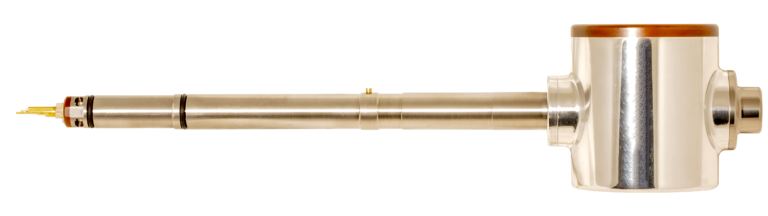
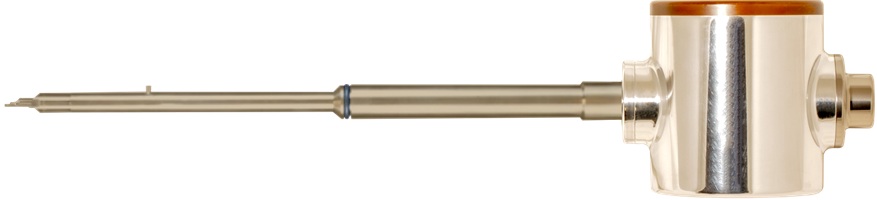
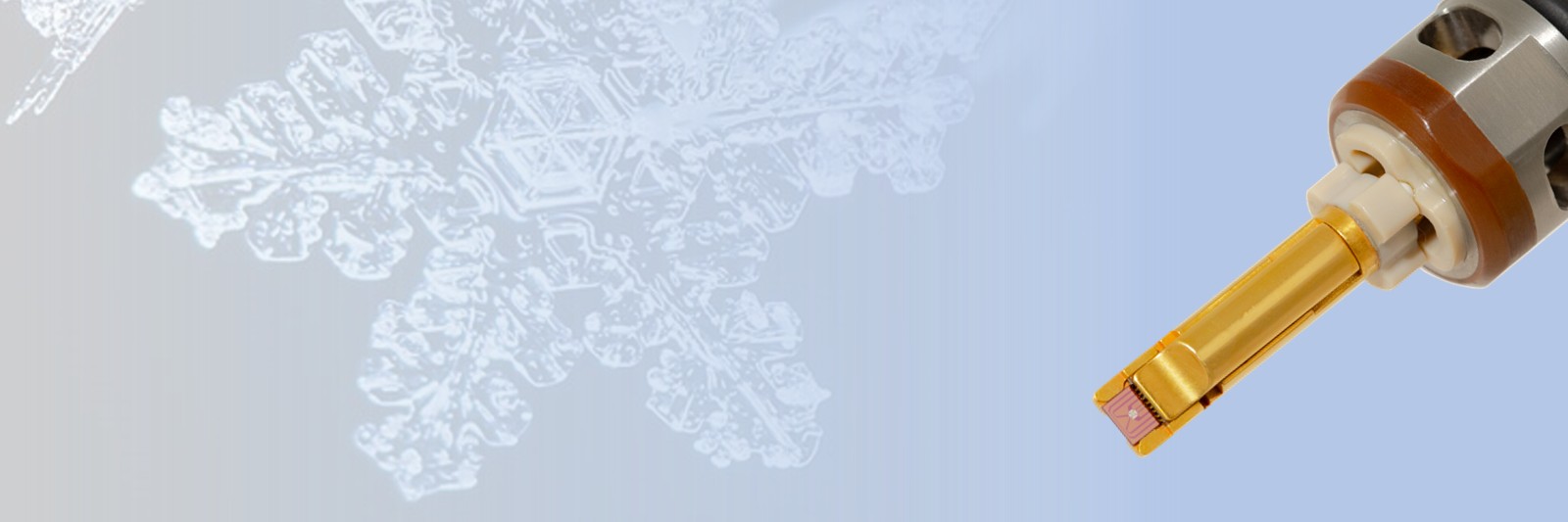
The Hummingbird Scientific TEM Cryo Biasing + Heating Sample Holder combines cryogenic cooling, high-temperature heating, and electrical biasing within a single in-situ TEM platform, enabling experiments from ~−170 °C to above 1000 °C. Designed for researchers in semiconductor devices, quantum materials, energy storage, low-dimensional materials, electronics, and materials science, it supports investigations of phase transitions, electrical transport, defect evolution, thermal stability, battery cycling, and device operation across an exceptionally wide temperature range. By correlating electrical and thermal stimuli with atomic-resolution imaging and analytical characterization, researchers can reveal the mechanisms governing temperature-dependent material behavior and device performance under realistic operating conditions.
Hummingbird Advantages:
- Variable-temperature operation from approximately −170 °C to above 1000 °C with precise closed-loop temperature control.
- Nine direct-chip electrical contacts for simultaneous electrical measurements and biasing.
- Screw-free direct MEMS chip insertion for fast, reproducible sample loading.
- Full compatibility with TEM, STEM, EDS, and EELS during heating and biasing experiments.
- Supports diverse experiments with FIB lift-out chips, multiple chip electrode materials and geometries, and custom MEMS chip designs.
- Compatible with TEM, SEM, and X-ray microscopy workflows using cross-platform microfabricated chips.
Available For:


.jpg)
How it Works
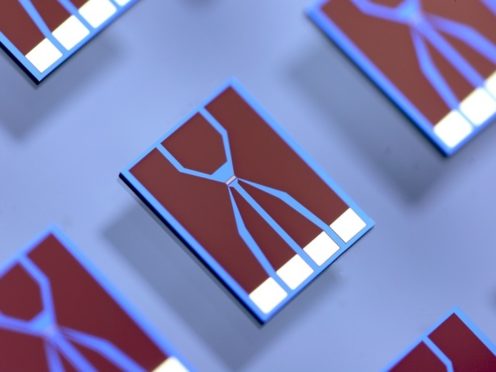
The TEM Cryo Biasing + Heating Sample Holder combines a liquid nitrogen cooling system, integrated electrical contacts, MEMS-based sample chips, and precision temperature control to create a stable platform for variable-temperature electrical biasing inside the TEM. Researchers mount samples directly onto a MEMS chip and load it using the direct chip insertion mechanism for fast, reproducible experiment setup.
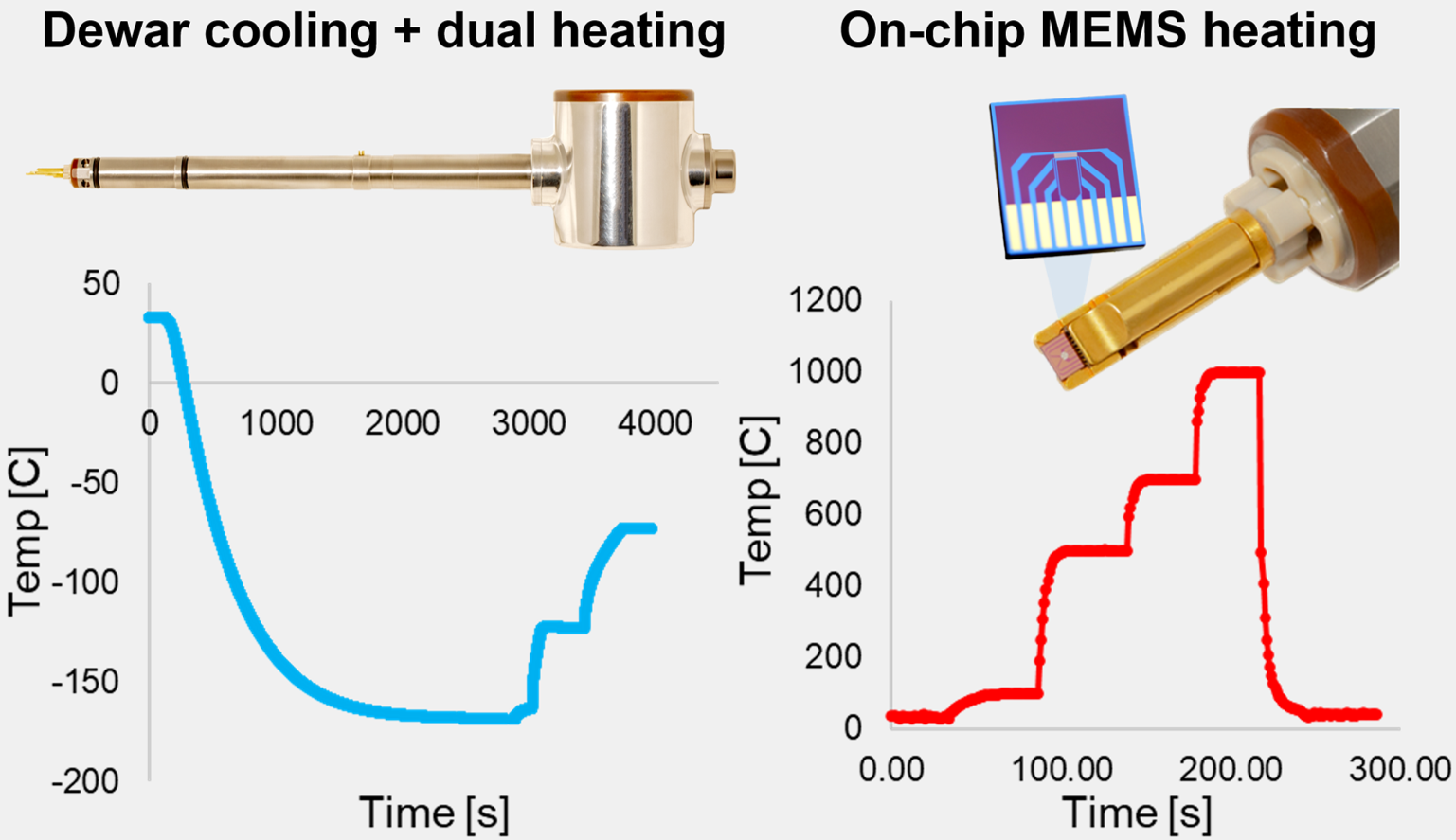
During operation, the liquid nitrogen Dewar cools the sample to ~−170 °C. A furnace heater and thermocouple sensor allow access to intermediate temperatures from ~−170 °C up to room temperature while MEMS-based heaters with an on-chip temperature sensor allow access to temperatures above 1000 °C. MEMS-based Heating + Biasing chips provide simultaneous thermal control and electrical biasing, allowing researchers to observe temperature-dependent structural, chemical, and electrical changes during real-time in-situ TEM imaging.
Direct chip insertion with nine electrical contacts provides reliable electrical connections for biasing experiments while maintaining stable imaging and analytical access throughout the operating temperature range.
Key Features and Capabilities
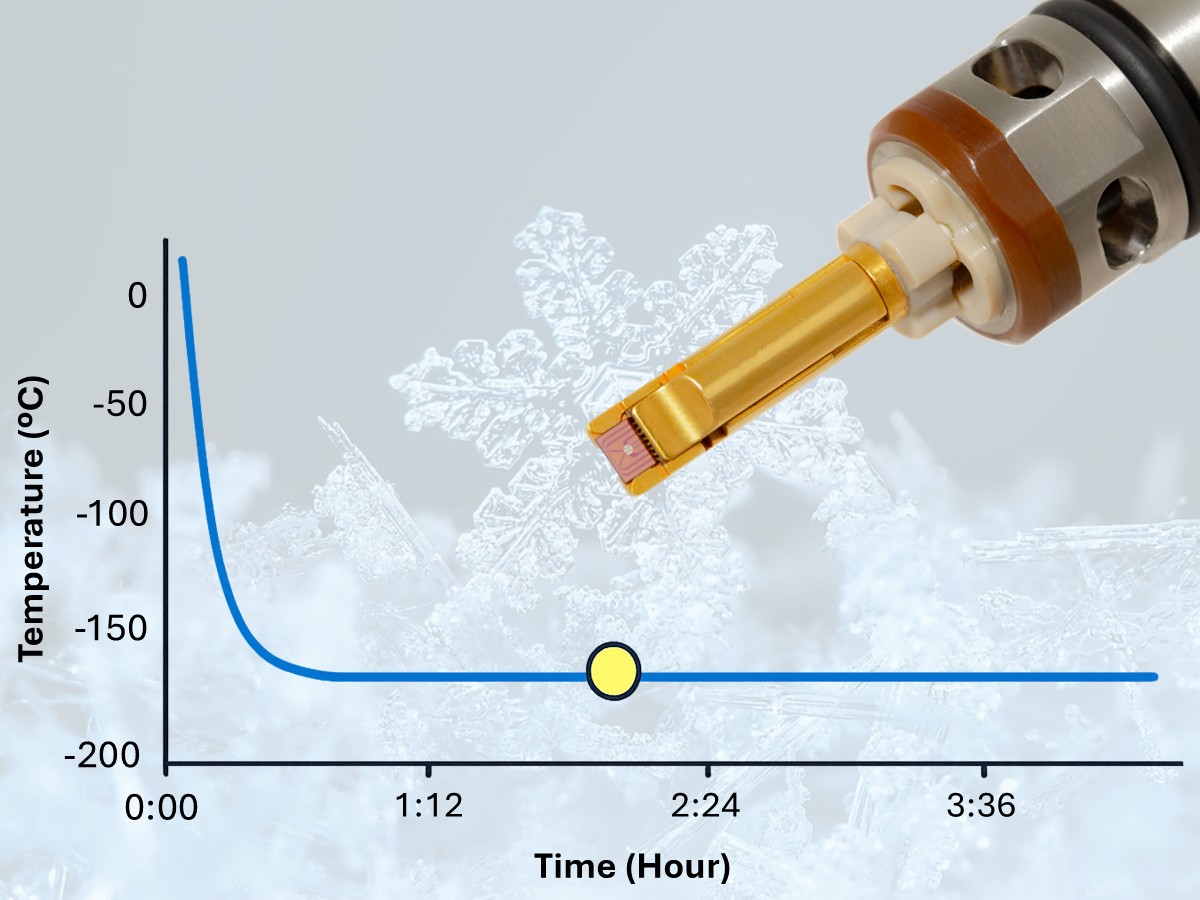
Perform stable electrical biasing experiments at cryogenic temperatures with precise temperature control
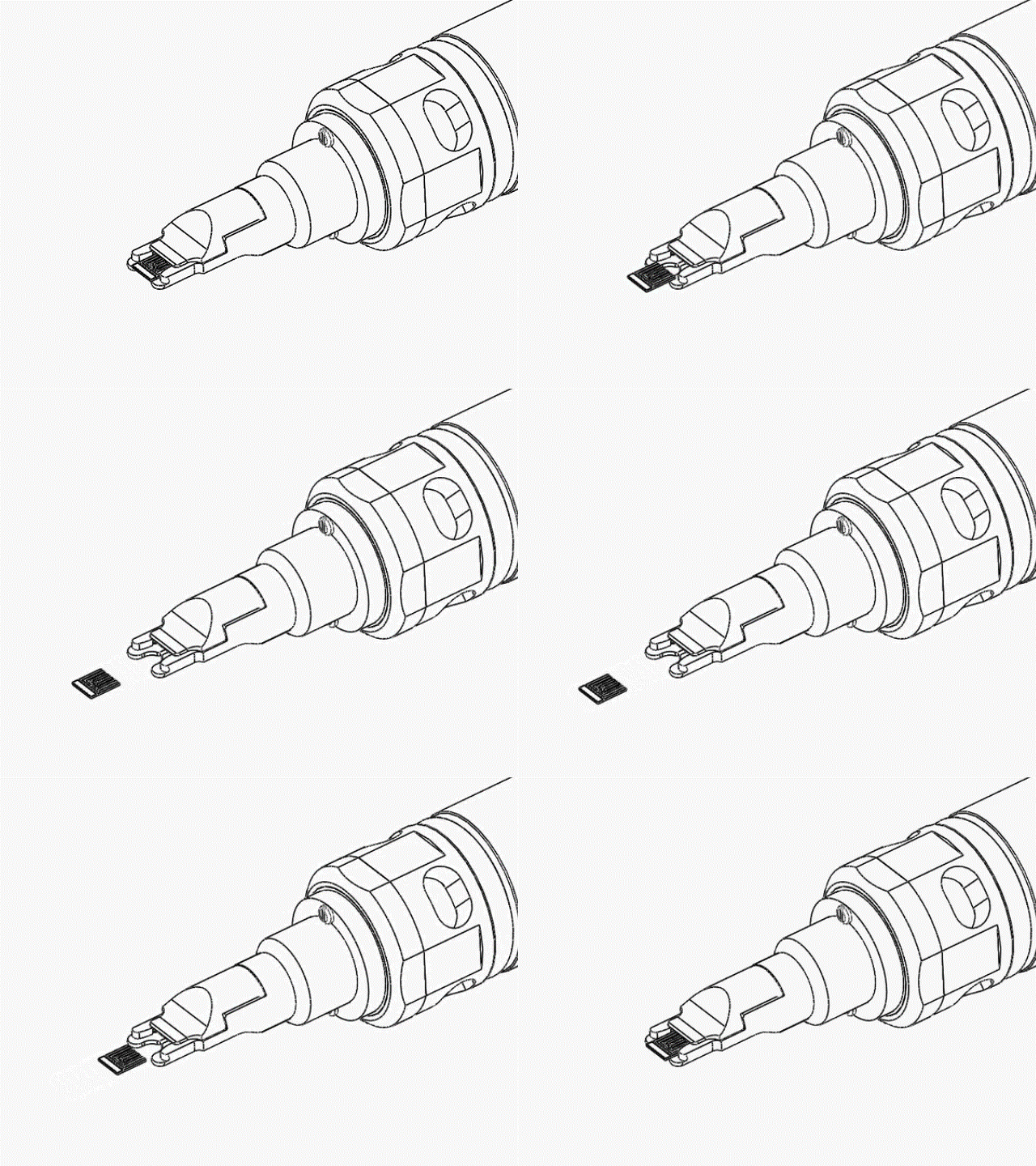
Load MEMS chips quickly with reliable electrical contact and simplified experiment setup
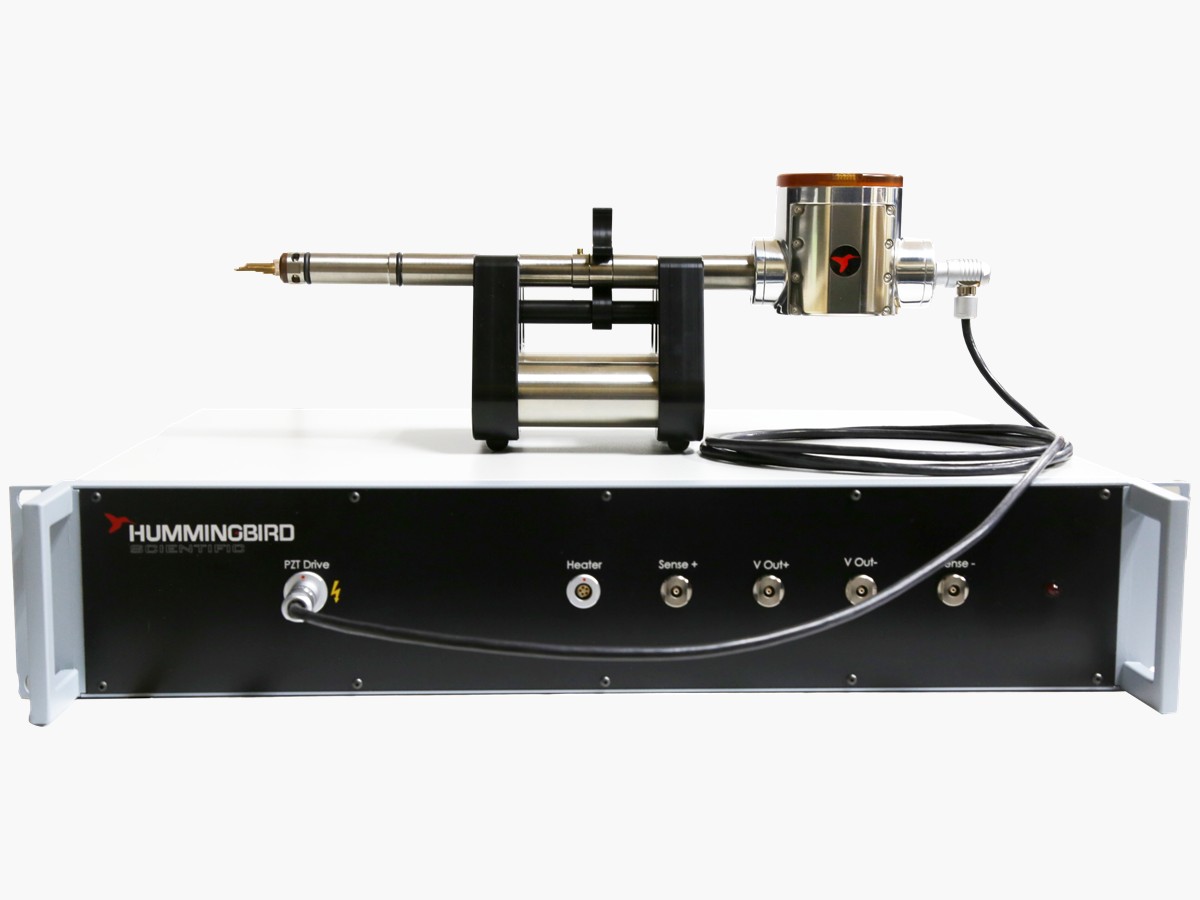
Perform low-noise in-situ electrical measurements with nine direct chip electrical contacts and individually shielded coaxial cables

Keep experiments moving with in-stock MEMS chips for heating, electrical biasing, and advanced in-situ TEM characterization
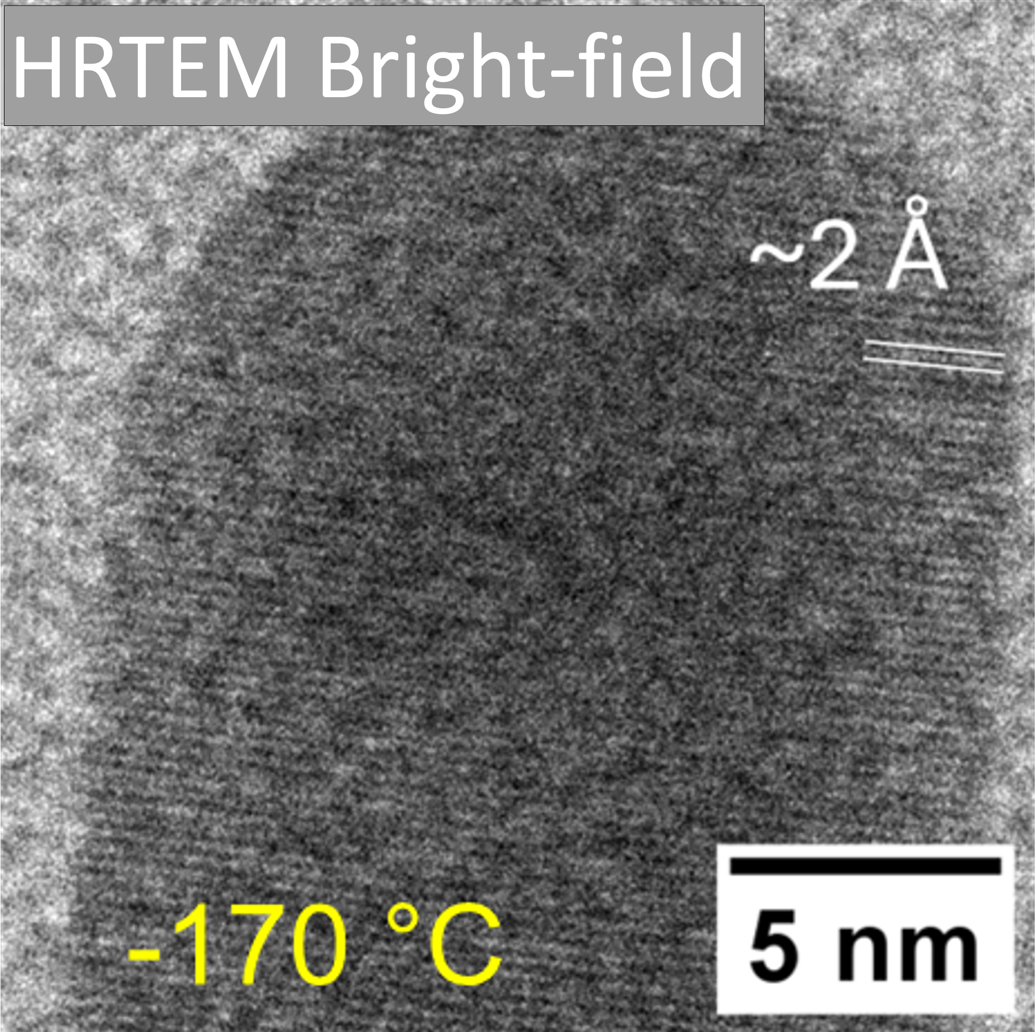
Maintain stable imaging with EDS and EELS compatibility throughout cryogenic in-situ TEM experiments
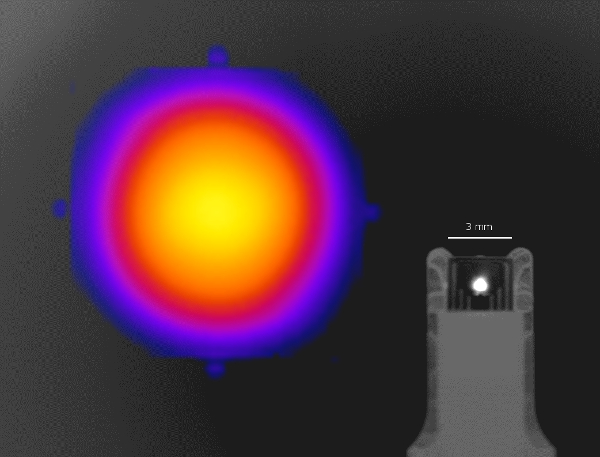
Expand from cryogenic cooling to variable-temperature electrical biasing with integrated MEMS heating to > 1000 °C
Built for Diverse Research Applications

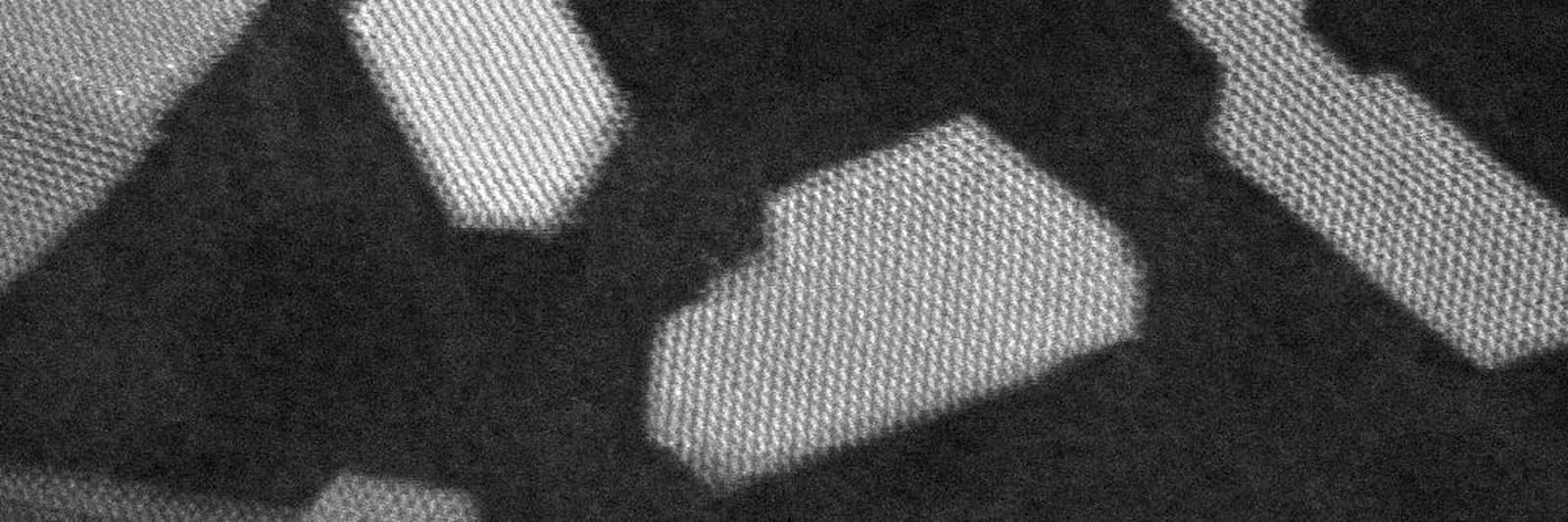
Featured Research
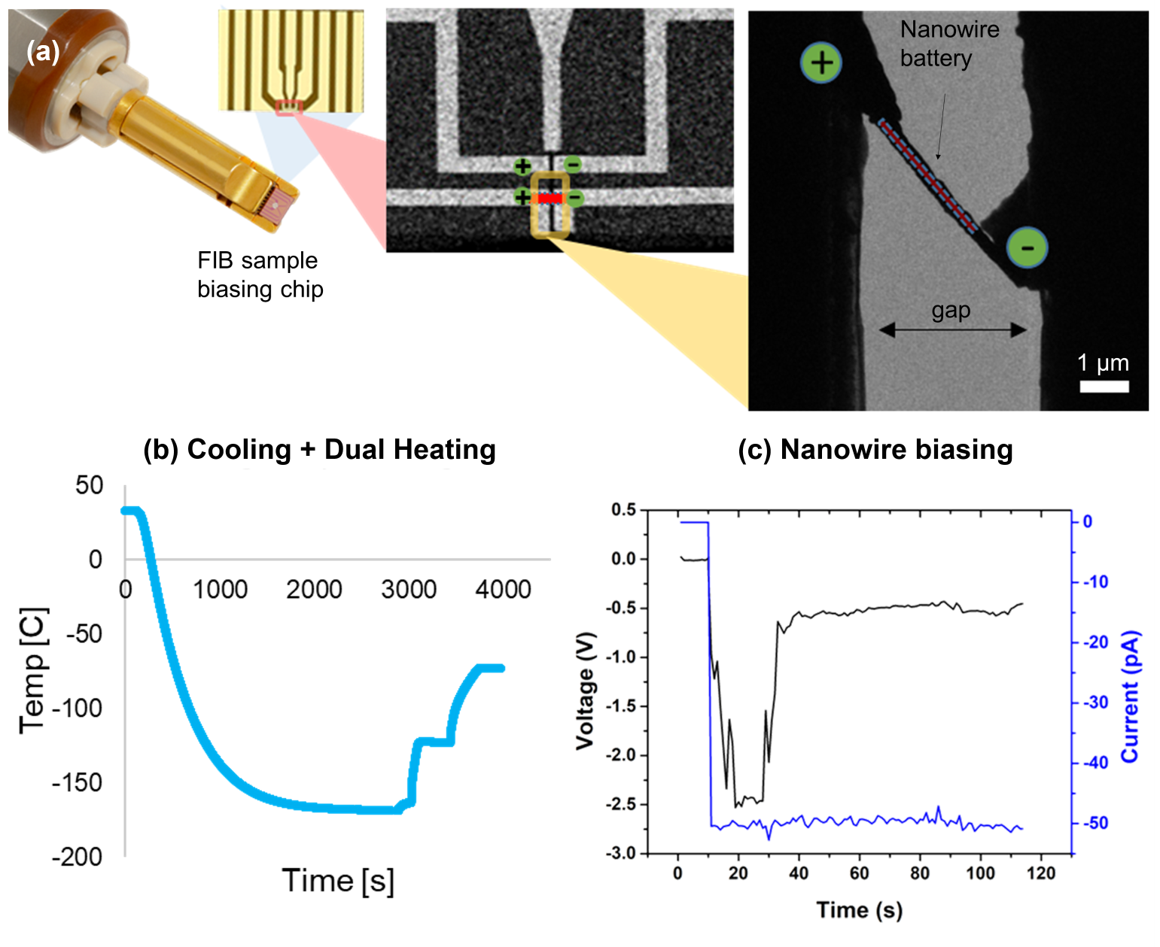
a) Multi-scale schematic showing cryo biasing holder tip, FIB chip, and mounted nanowire sample. b) LN2 cooling and dual heating function to access intermediate temperatures between-170 °C and room temperature. c) Current response at cryogenic temperature following the plating of a dendrite layer on the surface of the nanowire.
In-situ biasing of a nanowire at cryogenic temperature during dendrite plating reaction
Electrical biasing was performed at -170 °C on a nanowire sample bridging the electrodes on the biasing chip. Pre-patterned metal leads connect to electron transparent membranes or holes in the substrate to electrically bias the sample. The chronopotentiometric characteristic of the nanowire device shows that with constant pA-range current applied and measured at cold temperatures, the voltage drops across the nanowire as a reaction proceeds with the plating of a dendrite layer on the surface.
Reference: Internal Collaboration withUCSD/Battery500 Consortium
Software
Spend less time managing equipment and more time generating results. Hummingbird Control™ Software provides intuitive control of cooling, heating, and biasing functions, including temperature set points, closed-loop heating behavior, and voltage sweep workflows when configured with the system.
Hummingbird Connect™ can support the broader software strategy by connecting holder operation, microscope context, imaging workflows, and experiment metadata. Together, these software tools help improve reproducibility, experiment setup, data organization, and long-term usability for in-situ TEM heating and biasing experiments.
Built on Engineering Excellence
Hummingbird Scientific designs, machines, assembles, tests, and services its products in-house. Our integrated engineering, precision manufacturing, microfabrication, software development, applications, and service teams enable rapid prototyping and iteration, custom modifications, and direct technical support throughout the life of the instrument.
The TEM Cryo Biasing + Heating Sample Holder reflects this engineering approach by integrating cryogenic cooling, high-temperature heating, electrical biasing, and precision temperature control into a unified platform for reproducible variable-temperature in-situ TEM experiments. The holder, MEMS chip interface, controller, and software are engineered together to deliver stable performance from <−170 °C to >1000 °C.
Need something unique? Our engineers can customize holder configurations, MEMS chip designs, electrical interfaces, temperature-control workflows, and sample geometries to support specialized cryogenic and variable-temperature TEM experiments.
Frequently Asked Questions
Related Products


Customization and Service