The Future of Open Microscopy
The future of microscopy will be built on connected, open ecosystems
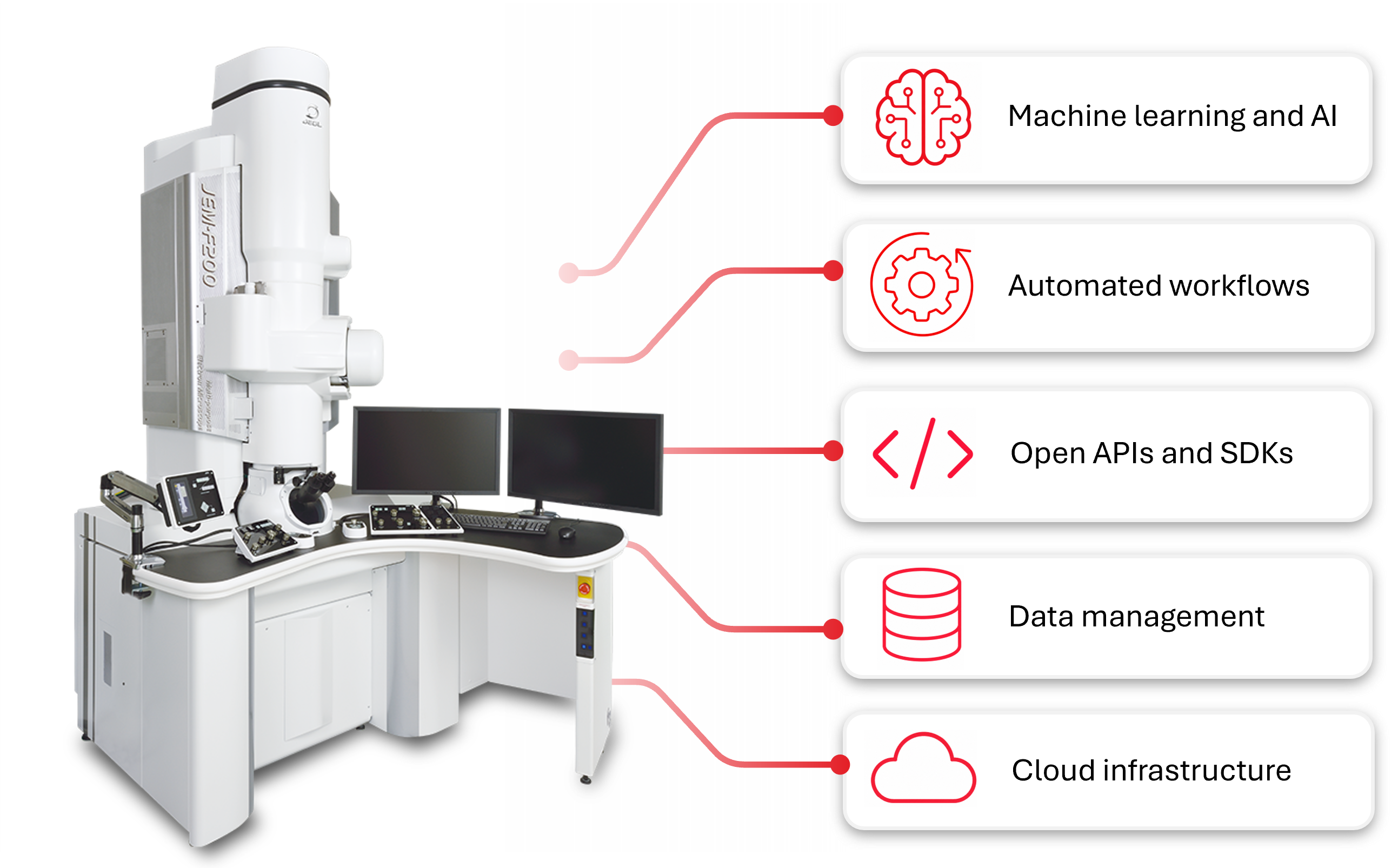

The future of microscopy will be built on connected, open ecosystems
Advanced in situ TEM, STEM, SEM, and X-ray microscopy increasingly depends on coordinated instruments, detectors, sample environments, stages, software, automation, data infrastructure, and people.
The next generation of microscopy will be defined not only by the performance of individual instruments, but by how reliably these systems work together. OEM software can remain central to microscope operation and acquisition. Hummingbird can connect the physical in situ experiment. Laboratories can retain control over the analysis, automation, data, and AI environments selected for their research.
Colibri Platform™ is Hummingbird Scientific’s open software and data platform for in situ microscopy. It includes Hummingbird Control™ for controlling and monitoring Hummingbird hardware, Hummingbird Connect™ for supported and project-specific software integrations, and an open approach to using experimental data across customer-selected environments.
From isolated instruments to coordinated systems
Microscopy is moving toward connected environments in which acquisition, precision motion, in situ control, analysis, automation, and scientific data infrastructure work together.
These capabilities do not need to exist inside one application. The microscope manufacturer can remain responsible for instrument operation and acquisition. Hummingbird systems can control and monitor the physical conditions surrounding and acting on the sample.
Facilities and researchers can continue using the software, data, and analysis environments that support their scientific goals.
The opportunity is not to place another proprietary layer between the researcher and the microscope. It is to create well-defined connections that preserve clear responsibilities, customer choice, and the ability to evolve as new technologies emerge.
Open workflows with clear support
Open does not mean unsupported. The future of open microscopy depends on robust products, documented boundaries, version control, calibration, safety systems, and accountable technical support. Colibri Platform™ is designed for that future.
The goal is not unrestricted access to every instrument function. It is a supportable architecture in which OEMs, accessory suppliers, facilities, and researchers can work together without creating fragile systems or unclear responsibilities.
A mature open workflow should preserve:
- OEM authority over microscope operation and safety
- Documented interfaces, configurations, and version boundaries
- Calibration, operating limits, and error handling
- Clear support, maintenance, and approval responsibilities
- Customer choice over analysis, data, automation, and AI
The physical experiment becomes connected scientific infrastructure
A microscopy experiment includes more than image files.
The holder, stage, chip, controller, detector, sample identity, position, calibration, and experimental conditions can all contribute to the scientific record. When available information is structured and connected through verified pathways, software can relate measurements to the physical experiment that produced them.
This creates a stronger foundation for reproducibility, remote operation, facility workflows, human-in-the-loop automation, and future AI development.
AI may increasingly help researchers identify features, select measurements, coordinate hardware, adapt experimental conditions, and analyze complex datasets. Its effectiveness will depend on reliable physical control, experimental metadata, accurate timing, measurable motion, defined safety limits, and verification that an intended action occurred.
Hummingbird’s role in the future of open microscopy
Hummingbird Scientific is building the control, integration, and hardware foundation needed to connect the physical in situ experiment with the next generation of software, automation, data, and AI environments.
Build the physical foundation for future automation
sample-environment systems. Depending on the product and configuration, it may also record, log, or export selected experimental-state information that can provide a foundation for future automation and AI workflows.
Connect evolving software environments
Hummingbird Connect™ supports defined and project-specific integrations between Hummingbird systems and OEM, facility, or customer-selected environments. These pathways can help future microscope workflows coordinate physical control, acquisition, analysis, and automation across multiple systems.
Keep future workflows open
Hummingbird sample environments, precision-motion development, software capabilities, and custom engineering can support workflows that evolve across OEM software, institutional infrastructure, open-source tools, Python workflows, and future AI environments.
The microscope manufacturer remains central to instrument operation and acquisition, while the laboratory retains control of the wider workflow.
Build the next microscopy workflow with us
The future of microscopy will depend on collaboration across microscope manufacturers, hardware developers, facilities, software teams, and researchers.
Tell us which microscope, Hummingbird system, software environment, and scientific outcome you are planning. Hummingbird can help evaluate the hardware control, experimental-state information, integration pathway, precision-motion requirements, and coordination needed to support the workflow.
Related Colibri Platform™ Pages
Explore how Colibri supports open, structured, and portable in-situ TEM data workflows:
- Colibri Platform™
- Hummingbird Control™ Software
- Hummingbird Connect™ OEM Integration
- In-Situ Experiment Data Management
- LIMS and Institutional Data
- AI-Ready TEM & SEM Workflows
- Open-Source TEM Software